

Why we wrote this guide
The phrase "shopping addiction" still sounds a little unserious. Like it should sit next to rom-com tropes and not next to actual clinical conversations. That framing has done damage. The behavior is real, the brain pathways are well documented, and somewhere around 5 to 8 percent of adults meet criteria for what researchers now call Compulsive Buying-Shopping Disorder (Maraz, Griffiths, & Demetrovics, 2016). The number is higher in younger adults, and higher again in people who do most of their shopping on a phone, which is most people now.
This guide isn't here to diagnose anyone, scare anyone, or sell anyone something. It's for the person who has been quietly wondering if their relationship with Amazon, Shein, TikTok Shop, or Temu has changed shape lately. Like the buying isn't really about the things anymore.
What you'll find below: a 1-minute self-check based on the most-used screening tool in the research literature, an explainer for the dopamine loop that powers compulsive buying, a breakdown of the patterns that show up most often, and the concrete first steps that actually help. Real sources at the bottom for anything you want to read more about.
A 1-minute self-check
Below is the Bergen Shopping Addiction Scale, developed by researchers at the University of Bergen in 2015 and validated across dozens of studies since (Andreassen et al., 2015). It's seven items, takes about a minute, and stays on your device. We don't store anything.
For each statement, pick the answer that fits you best over the last 12 months. Be honest. The score only means something if the answers do.
A note: the Bergen scale is a screening tool, not a diagnosis. A high score means the pattern is worth taking seriously, ideally with someone trained to look at it with you. A low score doesn't mean everything's fine, especially if you opened this guide for a reason.
A self-check is a starting point, not a verdict. If the score concerns you, the next moves are usually small and structural, not heroic. We'll get there.
What shopping addiction actually is
The clinical name in recent literature is Compulsive Buying-Shopping Disorder (CBSD). It's recognized in the ICD-11, the World Health Organization's diagnostic manual, under Other Specified Impulse Control Disorders. The DSM-5 (the American manual) doesn't have a standalone category yet, mostly because the field is still arguing about whether compulsive buying belongs alongside gambling, alongside OCD, or in its own slot (Müller et al., 2019). The behavior, though, isn't in dispute. Brain imaging studies show it activates the same reward pathways that other behavioral addictions do (Trotzke et al., 2019).
The behavior pattern looks like this:
- Persistent preoccupation with shopping or specific items
- Buying things you don't need, can't afford, or won't use
- Trying to cut back and not being able to
- Hiding purchases from people you live with
- Shopping to regulate mood (when stressed, sad, lonely, bored, or anxious)
- A "high" during the hunt that fades quickly after the purchase
- Financial, relational, or psychological consequences that don't stop the behavior
The first clinical description of this pattern was written in 1915 by the German psychiatrist Emil Kraepelin, who called it oniomania (Greek for "buying frenzy"). It's not a new condition. What's new is the environment.
Why your phone made it harder
Compulsive buying used to be limited by geography, store hours, and the slight social friction of walking into a store every day. The phone removed all three of those. Five things have changed in the last fifteen years:
One-click checkout removed the cooling-off period. The historical version of "I'll think about it" was the walk home. The phone version is a swipe. By the time the regret arrives, the package is in transit.
The hunt is endless. Amazon alone lists over 350 million items. The "shopping is done for the day" feeling barely exists anymore. There's always another tab.
The triggers are mixed into everything else. Instagram, TikTok, YouTube, Facebook marketplace. You don't have to go shopping anymore. Shopping comes to you, embedded in the same app you use to text your sister.
The targeting is uncomfortably good. The recommender systems have built a model of your weak spots. The 3 AM scroll surfaces exactly the thing you'd buy if your prefrontal cortex was offline. Which, at 3 AM, it is.
There's no public shame. Walking into Saks every day and buying handbags would draw stares. Doing it on the couch in pajamas doesn't, and the social brake that used to slow people down is gone.
The numbers say the same thing. The average American adult spends around 4 hours a day on a phone (DataReportal, 2024 Global Digital Overview). Mobile commerce now makes up over 60 percent of US e-commerce (Statista, 2024). If your shopping has crossed into compulsive territory, the phone is almost certainly the problem environment.
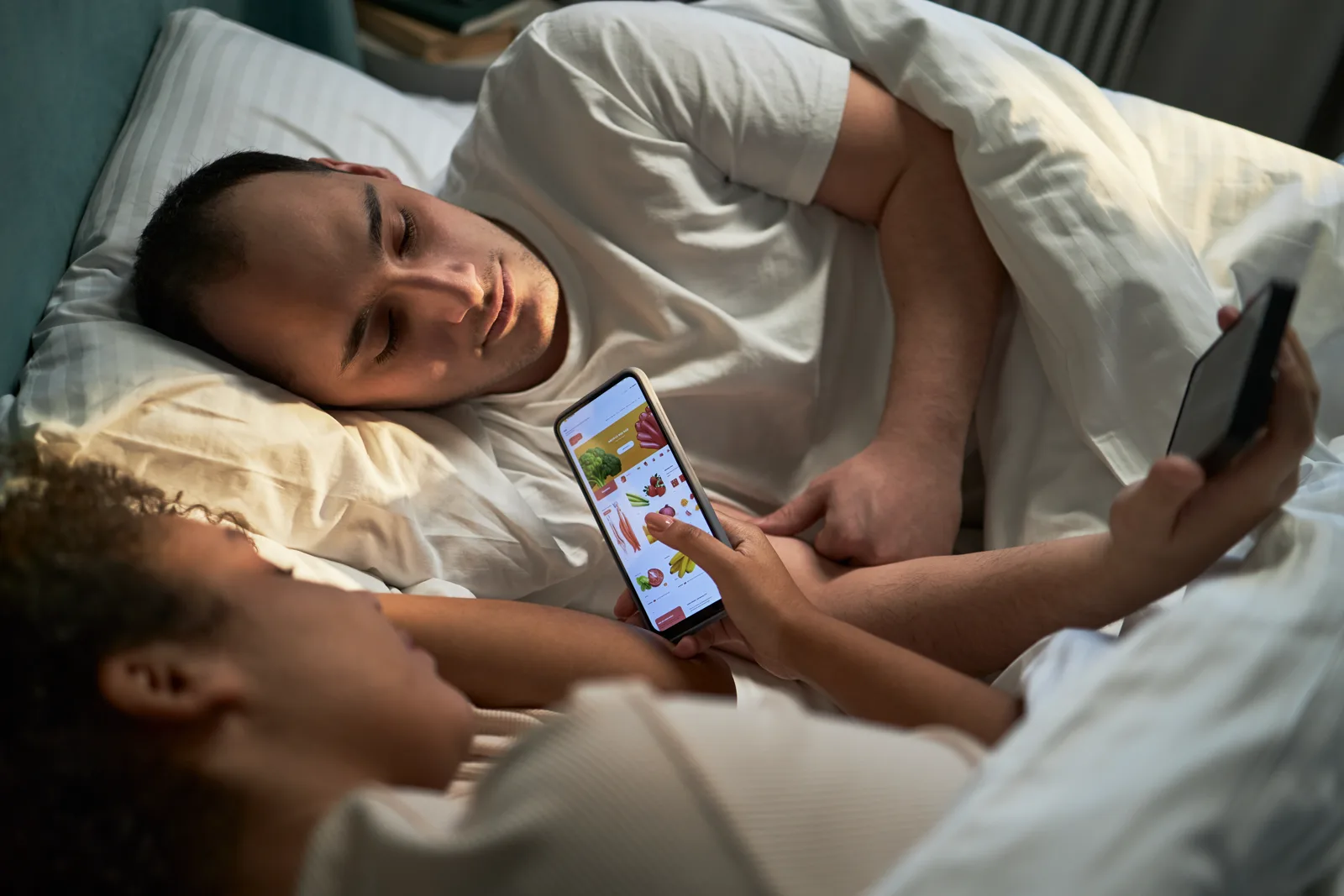
The dopamine loop
The simplest model for why compulsive shopping is sticky comes from the work of neuroscientists Kent Berridge and Terry Robinson, who spent decades drawing a clean line between wanting (driven by dopamine, all anticipation) and liking (driven by opioid systems, the actual pleasure of having). Their core finding, distilled: dopamine reinforces the chase, not the catch (Berridge & Robinson, 2016).
That insight explains why compulsive shopping doesn't make people happy and won't let go. Click each stage below to see how it works.
Trigger
A feeling you don't want to feel.
Anticipation
"Maybe I'll buy that thing."
Hunt
Searching, scrolling, comparing.
Purchase
The click. Smaller hit than you expect.
Drop
Trigger feeling comes back, often louder.
The cycle is what creates compulsion. The brain learns that "feeling bad" can be temporarily traded for "shopping," and the trade looks fair until you notice you keep making it. The shopping doesn't fix what's underneath. It just buys 30 minutes.
This is also why "just buy less" advice doesn't work alone. Asking someone in an active dopamine loop to use willpower is a little like asking someone with a sprained ankle to walk it off. The loop is structural. The fix has to be structural too.
Common patterns
Compulsive shopping isn't one thing. The clinical literature describes several recognizable subtypes (Black, 2007; Müller et al., 2015). They overlap. It can still be useful to notice which version sounds most like you.
The image buyer
Shopping is identity work. Clothes, accessories, beauty, home goods that "look like" the version of you that you want to project. Often heaviest in social-media-coded categories. The buying tends to spike before social events and after social comparisons.
The bargain hunter
The high isn't from the thing. It's from the deal. Coupons, flash sales, "you saved $40" notifications. The brain is rewarding the perceived win. This version is harder to spot because it feels productive. The closet keeps filling anyway.
The collector
One category, deep. Sneakers, vinyl, mechanical keyboards, Funko Pops, vintage cameras, makeup palettes. The hunt is for the next piece of a defined set. Adjacent to genuine hobbyism but the line is "do I open and use what I already have."
The mood regulator
The most common pattern. Shopping when stressed, sad, anxious, lonely, or bored. The category doesn't really matter. The act of buying is the medication. Frequently coexists with depression or anxiety and improves when the underlying mood issue is treated.
The numbing buyer
Shopping as zone-out. Late-night scrolling, half-conscious carting, "I don't remember ordering that." The buying happens during dissociated states, often when avoiding something. The packages arrive and the person is genuinely surprised. This is the version most enabled by phones.
Signs the pattern is yours
A useful rule of thumb: frequency matters less than control and consequences. Plenty of people shop a lot without it being a problem. The line is whether you can stop when you try, and whether the buying is costing you something that matters.
Behavioral signs:
- You've tried to cut back and you couldn't.
- You shop more when you feel bad.
- The buying mostly happens on your phone, often late at night.
- You have unopened packages or items still with tags.
- You have multiple shopping apps you can name without thinking.
Financial signs:
- Credit card balances you avoid checking.
- Buying things you can't afford comfortably.
- Using buy-now-pay-later for things you'd otherwise skip.
- Hiding purchases or hiding what they cost from a partner.
Emotional signs:
- A noticeable high when adding to cart and a low after.
- Guilt or shame after purchases that doesn't change the next time.
- The thought of being unable to shop feels distressing.
- You think about shopping at times you'd rather not be thinking about it.
The path back
Most people don't recover from compulsive shopping by trying harder. They recover by changing the environment so trying harder isn't the only lever they have. There's a real research literature on what helps. Three pieces tend to show up across most treatment approaches.
1. Change the environment first
The single highest-leverage move for most people is reducing access. That means phone boundaries: removing shopping apps from your phone or blocking them at certain hours, turning off email and push notifications from retailers, and unfollowing influencer accounts that act as triggers. For online compulsive shoppers, this isn't a "nice to have." It's the foundation everything else stands on. Treatment studies that don't address the access environment tend to underperform (Müller et al., 2015).
Some practical guardrails worth setting up in week one:
- Delete one-click purchase. Unsaved cards mean you have to retype the number. That tiny friction works.
- Turn off saved addresses on shopping apps so the same applies.
- Block shopping apps after a set hour. Late-night buying is consistently the highest-risk window.
- Unsubscribe from every retailer email (or filter them all to a folder you never open).
- Unfollow accounts whose content reliably ends in a purchase.
- Remove buy-now-pay-later apps. Klarna, Afterpay, Affirm. The fragmentation makes the total invisible, which is exactly what the brain in a loop wants.
2. Treat what's underneath
Compulsive shopping is often a coping strategy for something else. Depression, anxiety, untreated ADHD, loneliness, grief, and relationship strain are the most common underlying issues in the clinical literature. Treating the underlying cause usually softens the shopping behavior even before it's the direct focus of treatment. Cognitive behavioral therapy (CBT) has the strongest research base for compulsive buying specifically, often in a group format. Group CBT trials have shown meaningful reductions in buying urges and behavior at 6 and 12 month follow-ups (Mueller et al., 2008).
Medication has mixed evidence. SSRIs (most studied) help some people, often via the depression or anxiety pathway rather than via direct effect on buying. Worth a conversation with a doctor if your shopping coexists with low mood.
3. Add support
Behavioral addictions are hard to do alone. Two free, peer-led options have strong communities:
- SMART Recovery uses a CBT-informed approach in both in-person and online meetings. The framework adapts well to compulsive buying.
- Debtors Anonymous is a 12-step group for compulsive debt and spending. Best fit if you also have significant debt.
If you can afford a therapist, look for someone who explicitly works with behavioral addictions or compulsive buying. The Society for the Advancement of Behavioral Therapy maintains a US-based directory. Outside the US, ICD-11-aligned health systems increasingly cover this under impulse control disorders.

What to expect in the first six months
The first 30 days are usually the hardest because the dopamine loop is still firing on its old triggers. The urges don't disappear in week one. They get less sticky over weeks two through six as the brain stops getting reinforced. Most people see a meaningful drop in buying urges by month two with the structural changes in place. The harder work after that is what to do with the time and the feeling the shopping used to fill. That's where the underlying treatment matters most.
The structural fix is usually phone boundaries
Most modern compulsive buying happens in 6 to 8 phone apps you can probably name without looking. Our Phone Boundary Finder is a free 3-minute quiz that maps where your time and money actually leak, then hands you a personalized plan: which apps to block, when to block them, and what to put in front of them instead.
Try the Phone Boundary Finder Pax Gate is a mindful app blocker that runs the actual boundaries. One small pause before the apps you scroll without thinking.Use one of our free tools while you're here
If you're not sure where to start, three of our free Pax Tools tend to be the most useful for compulsive shopping:
- Phone Boundary Finder: the right place to start. Maps your specific leak points and prescribes the smallest set of boundaries that fix them.
- Screen Time Cost Calculator: estimates what your phone time is costing in money, sleep, and focus. The money figure can be uncomfortable for compulsive shoppers, and the discomfort is often useful.
- Phone Habit Trigger Finder: identifies which specific cues (boredom, anxiety, breaks at work, a notification) pull you into the apps. Compulsive buying always has a trigger underneath.
Pick one. Don't audit yourself to death. The point isn't the audit. The point is the change.
FAQ
What is shopping addiction?
Shopping addiction, more formally called Compulsive Buying-Shopping Disorder (CBSD), is a persistent pattern of buying behavior that the person can't stop despite negative financial, emotional, or relational consequences. It's recognized as a behavioral addiction in the World Health Organization's ICD-11. Roughly 5 to 8 percent of adults meet criteria for it, and rates are higher in young adults and heavy online shoppers.
How do I know if I have a shopping addiction?
The most-used screening tool is the Bergen Shopping Addiction Scale, a 7-item check developed by researchers at the University of Bergen in 2015. The behavioral signs are: persistent thoughts about shopping, buying to change your mood, trying to stop and failing, hiding purchases, feeling bad when you can't shop, and financial or relational consequences that don't change the behavior. If four or more of those resonate, the pattern is worth taking seriously.
Is shopping addiction a real mental illness?
Yes. The ICD-11 lists it under Other Specified Impulse Control Disorders. The DSM-5 (used in the US) doesn't have a standalone category yet, but the research community has been calling for one for years. Brain imaging studies show that compulsive buying activates the same reward pathways as other behavioral addictions like gambling. The science is solid.
What causes shopping addiction?
It's usually a mix. Common underlying factors: difficulty regulating emotions (shopping becomes a coping mechanism for stress, sadness, or boredom), childhood patterns around money or attention, depression or anxiety as a comorbid condition, and a brain that's particularly responsive to the dopamine reward of anticipation. The modern phone environment makes all of these worse: one-click checkout, infinite catalogs, algorithmic targeting, and 24/7 access remove the natural friction that used to slow people down.
How is shopping addiction treated?
The treatment with the most evidence is cognitive behavioral therapy (CBT), often delivered in a group format. Peer support groups like SMART Recovery and Debtors Anonymous help many people. Medications (mainly SSRIs) have mixed evidence. The structural piece almost everyone needs: phone boundaries and financial guardrails. Most modern compulsive buying happens on a phone, so changing that environment is often the lever that makes everything else easier.
What's the difference between shopping addiction and impulse buying?
Impulse buying is occasional and doesn't impair daily life. Shopping addiction is persistent, distressing, and continues despite consequences. A useful test: if you've tried to cut back and couldn't, if you've hidden purchases from people you live with, or if the buying is now affecting your finances or relationships, you've crossed the line into compulsive territory. Frequency matters less than loss of control and consequences.
Is online shopping more addictive than in-store?
For most people, yes. Five things stack the odds: one-click checkout removes the natural cooling-off period, the catalog is effectively infinite so the hunt never ends, the algorithm finds your weak spots, the triggers (Instagram, TikTok, Amazon) are mixed into every other app you use, and there's no public visibility, so the social brake doesn't kick in. Mobile commerce now makes up over 60 percent of US e-commerce, which is a useful number to sit with.
Can shopping addiction be cured?
"Cured" isn't quite the right word. It's more like other addictions: the brain pattern doesn't fully disappear, but the behavior can be brought under control, sometimes for life, with the right combination of structural change (phone, finances, environment), emotional regulation skills, and ongoing support. The first six months are the hardest. People who do the structural work in the first month tend to do significantly better long term.
Sources and further reading
- Andreassen, C. S., Griffiths, M. D., Pallesen, S., Bilder, R. M., Torsheim, T., & Aboujaoude, E. (2015). The Bergen Shopping Addiction Scale: Reliability and validity of a brief screening test. Frontiers in Psychology, 6, 1374.
- Berridge, K. C., & Robinson, T. E. (2016). Liking, wanting, and the incentive-sensitization theory of addiction. American Psychologist, 71(8), 670-679.
- Black, D. W. (2007). A review of compulsive buying disorder. World Psychiatry, 6(1), 14-18.
- Koran, L. M., Faber, R. J., Aboujaoude, E., Large, M. D., & Serpe, R. T. (2006). Estimated prevalence of compulsive buying behavior in the United States. American Journal of Psychiatry, 163(10), 1806-1812.
- Maraz, A., Griffiths, M. D., & Demetrovics, Z. (2016). The prevalence of compulsive buying: a meta-analysis. Addiction, 111(3), 408-419.
- Mueller, A., Mueller, U., Albert, P., Mertens, C., Silbermann, A., Mitchell, J. E., & de Zwaan, M. (2008). Cognitive-behavioral group therapy versus guided self-help for compulsive buying disorder: A preliminary study. Behaviour Research and Therapy, 46(5), 654-664.
- Müller, A., Mitchell, J. E., & de Zwaan, M. (2015). Compulsive buying. American Journal on Addictions, 24(2), 132-137.
- Müller, A., Brand, M., Claes, L., Demetrovics, Z., de Zwaan, M., Fernández-Aranda, F., et al. (2019). Buying-shopping disorder: Is there enough evidence to support its inclusion in ICD-11? CNS Spectrums, 24(4), 374-379.
- Trotzke, P., Starcke, K., Pedersen, A., & Brand, M. (2019). Cue-induced craving and symptoms of online buying-shopping disorder interfere with performance on the Iowa Gambling Task modified with shopping cues. Addictive Behaviors, 96, 82-88.
- World Health Organization. (2024). International Classification of Diseases (ICD-11). Other Specified Impulse Control Disorders.
- DataReportal. (2024). Digital 2024: Global Overview Report.
- Statista. (2024). Mobile commerce share of total US retail e-commerce sales.
- SMART Recovery (peer-led, CBT-informed support meetings).
- Debtors Anonymous (12-step program for compulsive debt and spending).
One last thing
If you've read this far, something landed. That's not nothing. Shopping addiction is one of the more shame-coated conditions a person can have, partly because the world keeps calling it a personality flaw. It isn't. It's a brain pattern that the modern phone is engineered to exploit. The pattern can change. Start with the smallest structural move you'll actually do this week, and let the next one come into view from there.