
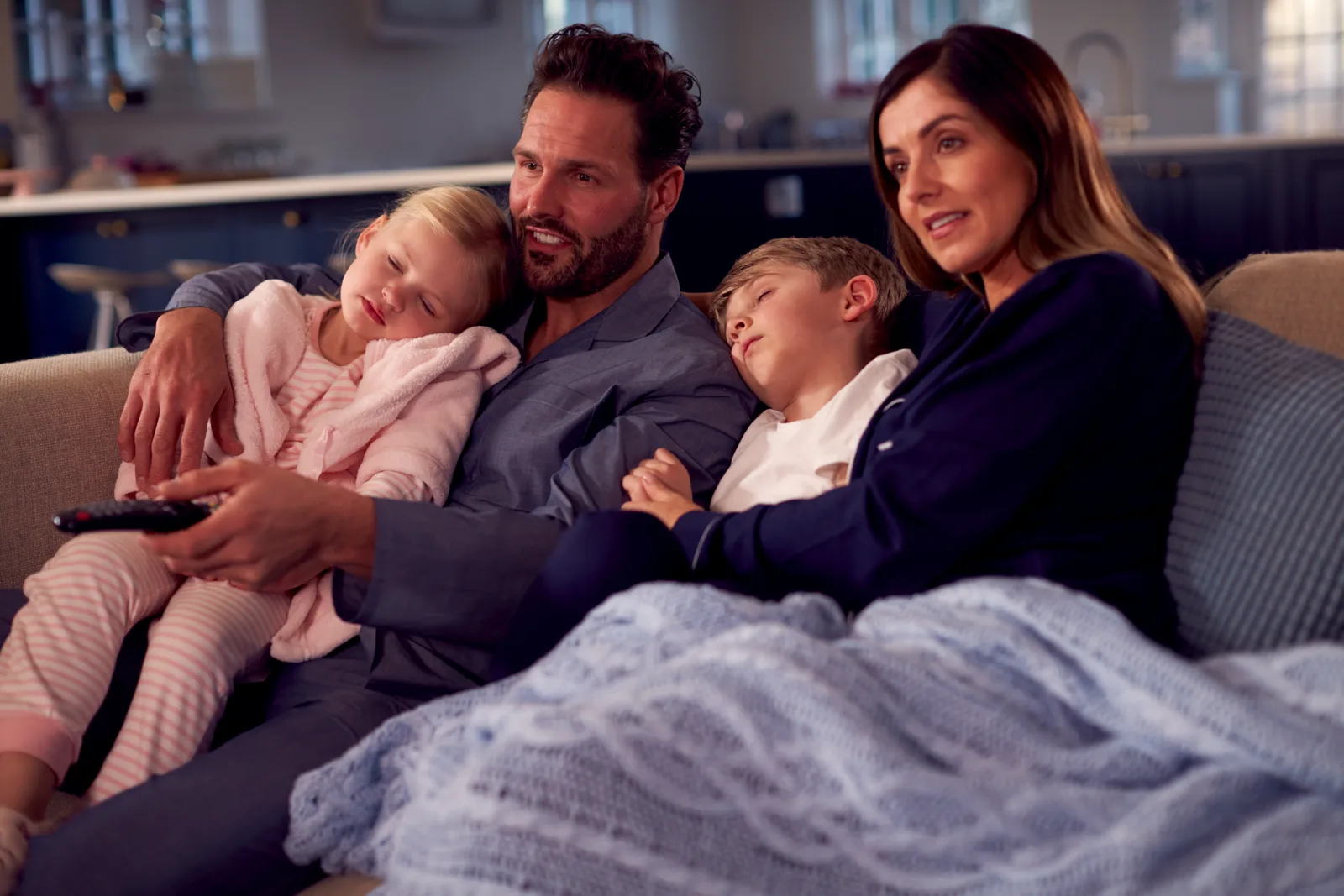
The Movie Night Picker
Tell it who is watching, the mood you are after, and the time you have. It returns a few classics that fit, with the top pick carrying a question to talk about once the credits roll.
Phones in the basket, lights low. The film only works if the room is actually watching it.
The film is the easy part. The magic is everyone under the same blanket, gasping at the same moment. That only happens if the phones are in the other room.
What makes a movie a "classic" family film
It is not the year it came out. Plenty of old films are forgotten and plenty of recent ones will last forever. What the durable ones share is that they take children seriously. They have a real story, real stakes, and a layer that lands differently for a child and an adult watching the same frame. The kid laughs at the slapstick; the parent catches the joke underneath it. The kid feels the fear; the parent feels the meaning. Nobody on the couch is being condescended to.
That double-decker quality is why a parent can rewatch The Princess Bride or Toy Story for the fortieth time and still feel something. A film built only to occupy a child is a babysitter. A film built to be felt by a whole family is the thing worth gathering for. The canon below is the second kind.
How to watch together so it actually counts
Movie night does its real work only if it is genuinely shared, and that takes a little intention. A few things that make the difference:
- Co-view, do not just co-locate. Watching the film together, reacting together, is what turns it from screen time into family time. Research on co-viewing finds that children get more from media and are better protected from its rougher edges when a parent is watching alongside and talking about it, not just in the same room on a separate device.
- Put the phones away. A movie half-watched against a scrolling feed is barely watched. The whole point is the shared attention, and a lit phone quietly dissolves it.
- Pick for the youngest, challenge the oldest. The best whole-family films do both at once. The picker sorts by who is watching so the four year old is not lost and the twelve year old is not bored.
- Talk about it after. Even one question. It turns ninety passive minutes into something you made together, and it is often where kids reveal what actually moved them. The picker hands you a question for each top pick.
Movie night and the phone want the same eyes
The entire value of movie night is the togetherness: the same story, the same gasp, the same laugh in the dark. A room of faces lit by separate phones loses all of it, and a great film becomes background noise to a feed. Research on phone presence (Ward and colleagues, 2017) shows a visible phone drains attention even when nobody is using it. The fix is to make movie night a phones-down ritual on purpose, basket by the couch, no exceptions. Pax Gate is the mindful app blocker we built for this. One small pause in front of the pull-you-away apps keeps the room with the film.
Join the Pax Gate waitlist The best scene in any family film is the row of faces watching it together.The canon, by category
If you would rather browse than use the picker, here is the shortlist organized by who it is for and what it does. None of these will let you down.
For the littlest (gentle, short, mild peril)
- My Neighbor Totoro (1988) and Paddington (2014) for sheer warmth.
- Toy Story (1995), Babe (1995), and The Muppet Movie (1979) for a first real story.
- Mary Poppins (1964) when you want a little magic and a lot of songs.
For the whole couch (works on every age at once)
- The Princess Bride (1987), Back to the Future (1985), and The Goonies (1985) for adventure with grown-up wit.
- E.T. (1982), The Iron Giant (1999), and the Pixar greats Up, WALL-E, and Finding Nemo for heart.
- Matilda (1996) and Home Alone (1990) for kid-powered fun.
For a magical afternoon (and a bit longer)
- The Wizard of Oz (1939), Willy Wonka and the Chocolate Factory (1971), and The NeverEnding Story (1984).
- Spirited Away (2001) for older kids ready for something stranger and deeper.
The musicals (great for a wide age range)
- The Sound of Music (1965), Singin' in the Rain (1952), and Mary Poppins again, because it earns two mentions.
A word on the scary and sad bits
Many of the greatest family films have a moment that stings: a parent lost, a villain who is genuinely frightening, a stretch of real peril. Parents sometimes treat these as flaws to screen out. They are usually the opposite. A story with real stakes is one a child can feel something about, and feeling something with a parent right there is exactly how kids learn to handle big emotions safely.
The move is not avoidance but timing and company. Know your own child; a sensitive four year old may need another year before the Lion King stampede. Watch the heavier films alongside them, not from the next room. And when the sad part comes, let it be sad, then talk about it. A frightening scene shared with a parent who is right there is a completely different experience from one watched alone on a tablet. That difference is the whole argument for watching together.
Some nights call for a game instead
When nobody can agree on a film, or you want something less passive, the companion guide has a filterable library of family games sorted by players, age, and the time you actually have.
Read the best family games guideRelated guides and tools
FAQ
What are the best classic family movies?
Titles that keep earning their place include The Wizard of Oz, Mary Poppins, E.T., The Princess Bride, Toy Story, The Lion King, My Neighbor Totoro, Paddington, Back to the Future, The Iron Giant, WALL-E, and Up. What they share is not an era but a quality: a real story that works on a child and an adult at once, so nobody is just enduring it. The picker above narrows the canon to a few that fit your couch tonight.
What is a good classic family movie for little kids?
For young children (roughly four to seven), the gentlest classics are safest: My Neighbor Totoro, Paddington, Toy Story, Babe, Mary Poppins, and The Muppet Movie. They move at a kind pace and keep the peril mild. Be a little careful with films that have an intense scene (the Lion King stampede), which can land hard on a sensitive four year old. The picker lets you set the youngest viewer so it only suggests films that fit.
What are good family movies for a wide range of ages?
The best whole-family films work on every age at once, with jokes and depth that land differently for a child and an adult. Strong picks: The Princess Bride, Back to the Future, Paddington, Toy Story, E.T., the Pixar canon (Up, WALL-E, Finding Nemo), Matilda, and The Goonies. These avoid being either too babyish for older kids or too intense for the youngest. Set the youngest viewer in the picker and it surfaces only films the whole room can share.
Why do so many classic kids movies have sad or scary parts?
Because the films that last take children seriously. A story with real stakes, loss, fear, a villain who is actually frightening, is one a child can feel something about, which is why it sticks for decades. The death in The Lion King, the peril in E.T. are features, not flaws; they give children a safe place to rehearse big feelings with a parent right there. The move is not to avoid them but to choose the timing, watch alongside, and talk afterward.
How do you do a good family movie night?
Pick the film for who is actually on the couch, not the most capable viewer. Watch it together rather than near each other; co-viewing is the difference between shared time and parallel screens. Put the phones away. Keep snacks simple and start early enough that nobody fades before the ending. And talk about it after, even one question, which turns ninety passive minutes into something shared. The picker hands you a question for each film.
What are the best classic family musicals?
The family musical canon is deep: Mary Poppins, The Sound of Music, Singin' in the Rain, Willy Wonka and the Chocolate Factory, Chitty Chitty Bang Bang, and The Muppet Movie. Musicals are unusually good for a wide age range, because a young child who cannot follow every plot beat can still ride the songs. The Sound of Music and Chitty are long, so save them for an afternoon rather than a school-night.
How long should a movie be for young kids?
For preschool and early-elementary children, a film under about 100 minutes fits an attention span far better than a two-hour epic, and a shorter film ends before the bedtime meltdown. Many of the best early classics are short by design: Toy Story is 81 minutes, The Lion King 88, Totoro 86. Save the long ones for a weekend afternoon with no clock to beat. The picker lets you filter by runtime.
How does phone use affect family movie night?
It quietly turns a shared experience into parallel solitude. The whole value of movie night is the togetherness, and a room of half-watched faces lit by separate phones loses it. Ward and colleagues (2017) found a visible phone drains attention even unused, and co-viewing only works if people are actually co-viewing. The fix is to make movie night a phones-down ritual on purpose. Pax Gate can hold that pocket so the film keeps the room.
Sources
- American Academy of Pediatrics, Council on Communications and Media. (2016). Media and young minds. Pediatrics, 138(5). (Guidance on co-viewing and media use.)
- Collier, K. M., et al. (2016). Does parental mediation of media influence child outcomes? A meta-analysis. Developmental Psychology, 52(5).
- Valkenburg, P. M., Krcmar, M., Peeters, A. L., & Marseille, N. M. (1999). Developing a scale to assess three styles of television mediation. Journal of Broadcasting & Electronic Media, 43(1).
- Ward, A. F., Duke, K., Gneezy, A., & Bos, M. W. (2017). Brain drain: The mere presence of one's own smartphone reduces available cognitive capacity. Journal of the Association for Consumer Research, 2(2).
One last thing
Your kids will not remember most of the films you watch. They will remember the watching: the spot on the couch, the blanket, the one who always cried at the sad part, the line everyone still quotes years later. The movie is the occasion. The thing you are actually making is a pile of ordinary evenings that add up to a childhood. Pick one tonight, put the phones in the other room, and press play on something worth gathering for. Then ask them what they thought when it ends. That last part is where the night becomes a memory.