
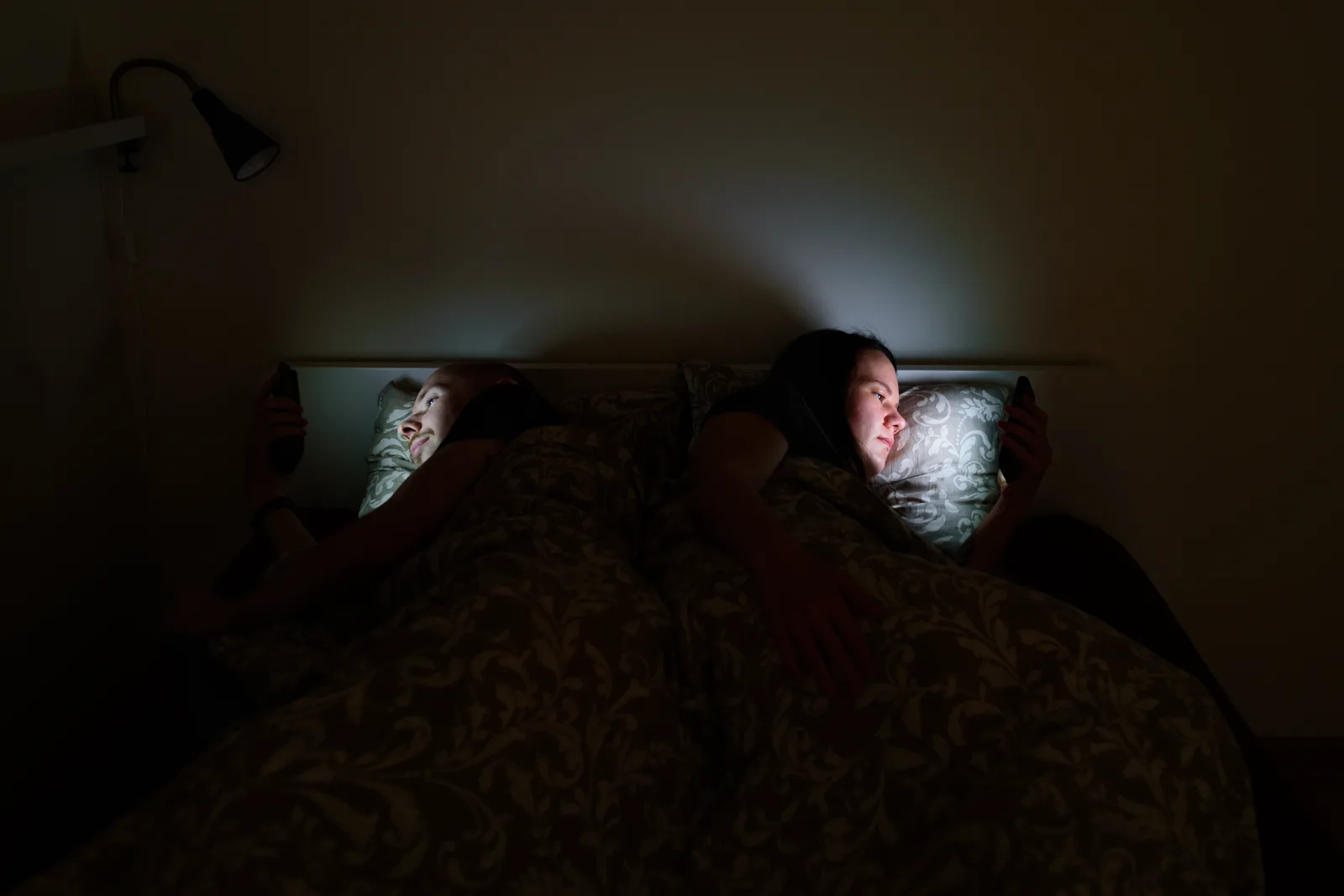
The Sleep-Cost Calculator
Be honest about the in-bed scroll, roughly how long it runs and how many nights a week, and the calculator adds up what it costs, not just tonight, but over a week and a year. The yearly number tends to be the one that lands.
The number the calculator shows is only the time. The quieter cost is the quality: even the sleep you do get is lighter and more broken after a doomscroll. You are paying twice, and the second charge is the bigger one.
Two costs, not one
The obvious cost of the bedtime scroll is time. "Ten more minutes" becomes forty, your sleep onset slides later and later, and you lose sleep straight off the front of the night. That is what the calculator counts, and it adds up faster than anyone expects. But the time is only half of it, and honestly the smaller half.
The second cost is quality. A doomscroll does not just delay sleep; it actively degrades the sleep you eventually get, because of what it does to your body and brain in the minutes before you drift off. This is why two people who both go to sleep at midnight can wake up feeling completely different: one read a book until 11:40 and lay quietly, the other doomscrolled until 12:00. Same lights-out, very different night. The scroll leaves a residue that the clock does not show.
Why the light and the content both fight your sleep
Two mechanisms are at work. The first is light. The bright, blue-tilted light of a screen held close to your face in the evening can suppress melatonin, the hormone that signals your body it is time to sleep, and nudge your internal clock later. In one well-known study, evening use of a light-emitting device delayed melatonin, pushed back sleep timing, and reduced next-morning alertness compared to reading a printed book (Chang and colleagues, 2015).
The second, and for doomscrolling the bigger one, is arousal. Falling asleep requires your physiological and mental arousal to drop. Doomscrolling drives them up. A stream of alarming, outrageous, or emotionally charged content switches on your threat system, nudges up cortisol, and sets your mind racing, exactly when both need to be powering down. That is why you can put the phone down and still lie there wired: the content has left your nervous system in the wrong gear. Ordinary phone use mostly costs you through light and time; doomscrolling adds this active mental arousal on top, which is often what actually keeps you awake.
At the hour you have the least willpower, don't rely on willpower
The cruel timing of the bedtime scroll is that your self-control is at its lowest exactly when the feed's pull is unopposed. That is a fight you will usually lose. Pax Gate is a mindful app blocker that takes the fight off your hands. Put a pause on your feed and news apps in the evening, and the reflexive bedtime open meets a breath and a choice instead of an instant scroll, so "just one more" runs into a gentle gate rather than an infinite feed. It is the structure that works precisely because it does not depend on the willpower you do not have at midnight.
Join the Pax Gate waitlist A gate on the feed for the hour you can least resist it.The 3am doomscroll
There is a second, sneakier version: waking in the night and reaching for the phone. Waking briefly is completely normal; everyone surfaces between sleep cycles and usually drifts back down without remembering it. But a doomscroll turns that harmless two-minute wake into a thirty-minute one. The light nudges you toward wakefulness, the alarming content spikes your arousal, and the mind that was about to sink back into sleep is now wide awake and worried at 3am, the hour when everything feels worst. Do it enough and you train your brain to wake more fully at that time, looking for the phone. The fix is the same as for the bedtime scroll and even more effective: keep the phone out of arm's reach so the night wake has nothing to grab.
Already in bed and the scroll has you? Reset it
For the nights the doomscroll wins anyway, the Bedtime Scroll Reset walks you through a short, guided wind-down to bring your arousal back down and hand the night back to sleep, tuned to where you are right now.
Try the Bedtime Scroll ResetRelated guides and tools
FAQ
Why is doomscrolling before bed bad for sleep?
It harms sleep in two ways. First is the time cost: the scroll pushes your sleep onset later, so you lose sleep off the front of the night. Second, and more important, the light from the screen can suppress melatonin and nudge your body clock later (Chang and colleagues, 2015), and the content, especially alarming doomscroll content, keeps your mind aroused and your nervous system alert exactly when both need to wind down. So you are not just delaying sleep; you are making it harder to fall asleep once you stop, and often lowering its quality. A doomscroll combines the wrong light with the most activating content.
Why is doomscrolling worse for sleep than other phone use?
Because it adds emotional and cognitive arousal on top of the problems any screen causes. Any bright screen before bed can suppress melatonin and delay your clock, so even a calm show is not ideal. But doomscrolling piles on the most activating content: alarming, outrageous, anxiety-provoking material that switches on your threat system right when it needs to power down. Sleep requires a drop in arousal, and doomscrolling does the opposite, raising cortisol and setting your mind racing, leaving you wired even after the phone is down. Ordinary phone use costs you through light and time; doomscrolling adds active mental arousal, often the bigger sleep-killer.
How long before bed should I stop scrolling?
Aim for at least thirty to sixty minutes of no screens before your target sleep time, and treat that cutoff as the anchor of your wind-down. An hour is ideal, giving melatonin time to rise and your nervous system time to come down. If a full hour feels impossible, start with a realistic cutoff, even fifteen minutes, and extend it. The most effective version is keeping the phone out of the bedroom entirely and charging it in another room, since you cannot doomscroll a phone you cannot reach. If it must stay in the room, put a pause in front of your feed apps so the bedtime open meets a choice rather than an instant scroll.
Does doomscrolling in bed cause insomnia?
It can contribute and can turn occasional wakefulness into a more entrenched problem. The mechanism is a loop: doomscrolling raises arousal and delays sleep, the resulting poor sleep leaves you more anxious and more prone to reaching for the phone the next night. Doing it in bed is especially counterproductive because it teaches your brain to associate the bed with alert wakefulness rather than sleep, the exact association stimulus-control therapy works to break. It is not the sole cause of clinical insomnia, which has several drivers, but it is a genuine aggravator and often a maintaining factor. If insomnia persists, address it properly; cutting the bedtime scroll is a straightforward place to start.
Why can't I stop scrolling even when I'm tired?
Two things work against you at the worst moment. The feeds are engineered to be hard to stop, infinite, variable-reward, autoplaying, regardless of how tired you are. And your self-control is at its lowest when you are tired, so the part of you that would stop is depleted right when the pull is unopposed. There is often a third factor, revenge bedtime procrastination, staying up scrolling to claim personal time the day did not give you, so stopping feels like giving up your only free hours. A bottomless feed, low willpower, and a felt need for time of your own is why exhaustion so rarely translates into putting the phone down. The fix is structural.
What should I do instead of scrolling before bed?
Replace the scroll with a low-light, low-stimulation wind-down: a paper book or app-free e-reader, a warm shower or bath, light stretching, slow breathing or a body scan, a brief journal or brain-dump, or quiet music. The common thread is lowering arousal rather than raising it, the opposite of a doomscroll. Just as important is where the phone goes: charging it outside the bedroom removes the temptation structurally, so you are not relying on willpower at the hour you have least of it. If the phone must stay in reach, a pause in front of your feed apps turns the bedtime reach into a decision. A short, consistent routine becomes your runway to sleep.
Sources
- Chang, A. M., Aeschbach, D., Duffy, J. F., & Czeisler, C. A. (2015). Evening use of light-emitting eReaders negatively affects sleep, circadian timing, and next-morning alertness. PNAS, 112(4).
- Exelmans, L., & Van den Bulck, J. (2016). Bedtime mobile phone use and sleep in adults. Social Science & Medicine, 148.
- Yoo, S. S., Gujar, N., Hu, P., Jolesz, F. A., & Walker, M. P. (2007). The human emotional brain without sleep. Current Biology, 17(20).
- Bootzin, R. R., & Epstein, D. R. (2011). Understanding and treating insomnia. Annual Review of Clinical Psychology, 7. (On stimulus control and bed associations.)
One last thing
The bedtime scroll makes a promise it never keeps. It offers to help you unwind, to give you a little pocket of pleasure at the end of a hard day, and instead it quietly robs you of the one thing that would actually make tomorrow better. You deserve the rest more than you deserve the feed. Put the phone in another room, give the last half hour of your day to something that slows you down instead of winding you up, and let sleep come the way it wants to, from a calm body in a dark room. The feed will still be there in the morning. Your sleep, once it is gone, is gone.