
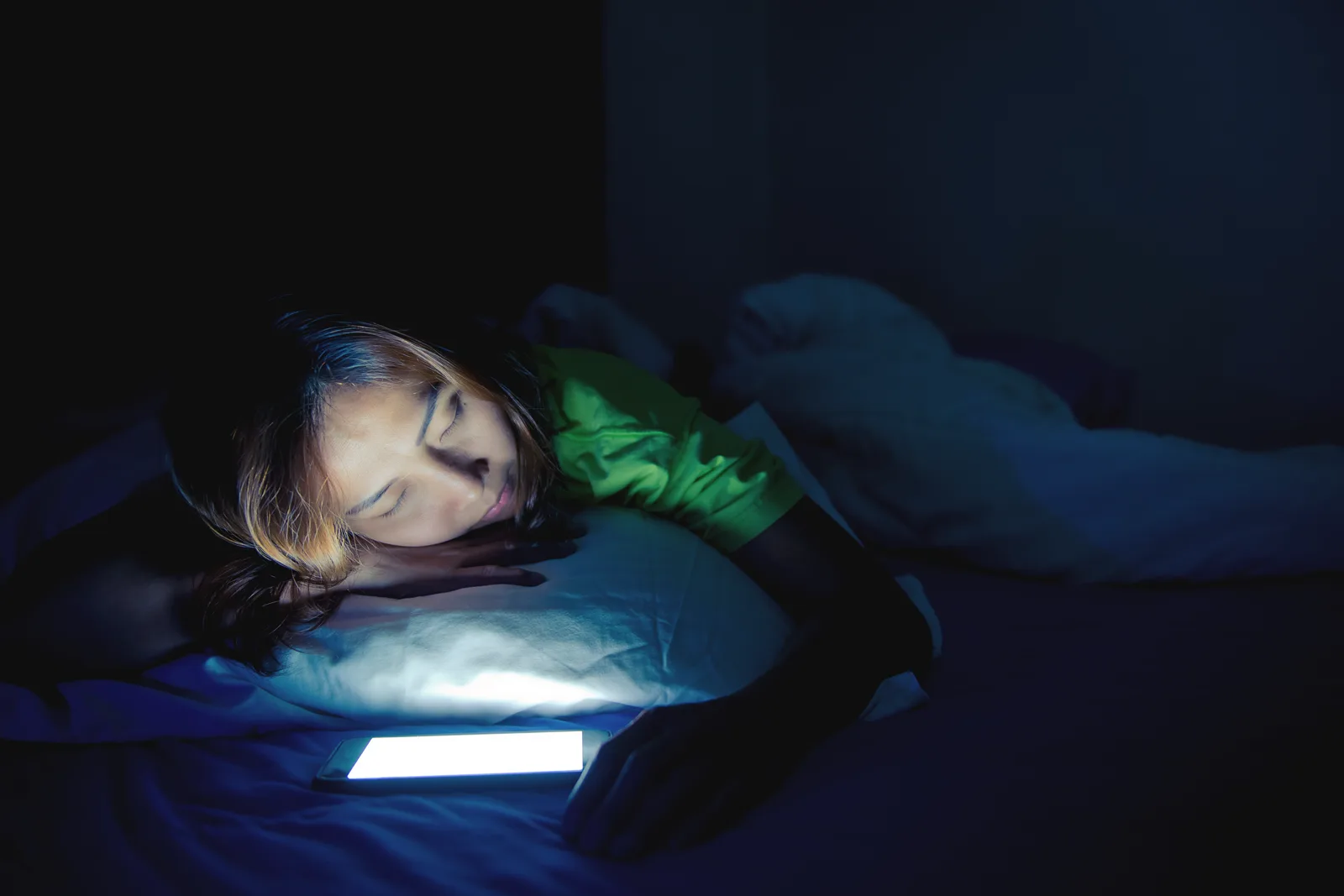
The Bedtime Scroll Diagnostic
Pick the honest reason your hand keeps finding the phone at night. The diagnostic returns what is actually driving it, the fix that matches that driver, and the thing not to bother trying, since the wrong fix for the wrong driver does nothing.
You are not weak for scrolling at night. You are tired, and the phone is the easiest thing in the room. Change what is easiest, and the willpower takes care of itself.
Why the scroll is so much worse at night
Bedtime scrolling is uniquely damaging, for two reasons that stack on top of each other. The first is the one everyone knows: light. Screens emit light in the blue range that can suppress melatonin and nudge your body clock later. Chang and colleagues (2015) found that people who read on a light-emitting device before bed took longer to fall asleep, produced less melatonin, and were groggier the next morning than people who read a printed book. The night mode and blue-light filters help a little, but they are not the whole story.
The second reason is bigger and less discussed: arousal. Sleep requires your mind and body to power down, and the content on your phone is engineered to do the opposite. The argument in the comments, the news that spikes your stress, the video that pulls you into one more, the message that makes your heart jump, all of it raises mental activation at exactly the moment you need it to fall. Research links bedtime smartphone use to poorer sleep quality and more daytime fatigue (Exelmans and Van den Bulck, 2016). You can filter the light. You cannot filter the wakefulness that a feed built to hold your attention creates in your head.
The five reasons you can't stop
The diagnostic gives you your driver. Here is the full picture of each, because the fix is different for every one, and this is why generic "put your phone down" advice fails so reliably.
Boredom: the phone fills the quiet
The day is over, there is nothing left to do, and the empty stretch before sleep feels uncomfortable, so the phone fills it. This is the most common driver and the most misunderstood.
The fix: give the boredom a better, low-stimulation landing rather than trying to tolerate an empty void. A paper book, an e-reader with warm front-lighting, quiet music, or just permission to lie in the dark and let your mind wander. The boredom is not the problem to solve; it is the doorway to sleep.
Anxiety: it numbs the thoughts you don't want
The moment the lights go out, the thoughts arrive: the worry, the replay, the tomorrow-list. Scrolling numbs them. The phone is not entertainment here; it is anesthetic.
The fix: deal with the thoughts rather than muting them. A worry brain-dump earlier in the evening, a genuine wind-down, or a soothing practice at lights-out. If night anxiety is a regular visitor, the companion guide on nighttime anxiety and phone use breaks the specific loop.
Habit: your hand does it on autopilot
You are not even deciding to scroll. You get into bed and the phone is in your hand before you notice, because bed itself has become a cue to scroll.
The fix: break the cue by changing the environment, not the intention. Charge the phone in another room and use a standalone alarm, so the automatic reach finds nothing. If you cannot manage that, at least put it across the room. You cannot autopilot toward a phone that is not within arm's reach.
One-more-check: you can't let go until you're caught up
Just one more look at the messages, the news, the notifications, and then you will put it down. Except the one check becomes twenty minutes, every night.
The fix: a hard communications cutoff and the honest reminder that nothing needs you at 11pm. Set a "closed for the night" time, and let the world's updates wait until morning, when they will still be there and you will be rested enough to care.
Revenge bedtime procrastination: the only time that's yours
Your whole day belongs to other people, work, kids, obligations, and the only unclaimed hour you get is after everyone is asleep. So you steal it from sleep, and you spend it on the phone.
The fix: the honest one is to find some real personal time earlier in the day so the night does not have to carry all of it. And when you do take night time, choose a reward that does not wreck your sleep, a chapter of a book, a bath, a genuinely restful thing, rather than the feed that leaves you wired and still unsatisfied.
For the nights the phone has to stay, put a gate on it
Getting the phone out of the bedroom is the gold standard, but it is not always realistic, and some nights the phone comes to bed. Pax Gate is a mindful app blocker built for exactly that moment. It puts a small pause in front of the apps you open on autopilot, so the late-night reach for the feed meets a breath and a choice instead of an open door. It turns the reflex that steals your sleep into a moment where you actually decide.
Join the Pax Gate waitlist A pause at the door of the feed, right at the hour your willpower is lowest.The one structural fix that beats all the willpower techniques
If you read nothing else, read this: get the phone out of the bedroom. Charge it in the kitchen or the hall, and buy a cheap standalone alarm clock so you have no excuse to bring it in. This one change does more than every willpower trick combined, because it removes the temptation instead of asking you to resist it in the dark, half-asleep, at the exact moment your self-control is at its weakest.
The principle behind it is stimulus control, a cornerstone of sleep science: your bed should be a cue for sleep and almost nothing else. Every night you scroll in bed, you train your brain that bed is a place for wakeful engagement, which quietly erodes your ability to fall asleep there at all. Removing the phone reverses the training. If a fully phone-free bedroom genuinely is not possible, the Bedside Phone Replacement Finder helps you find the alarm clock and setup to make it work, and the nightstand guide covers what to put there instead.
Replace the scroll with a whole routine
Removing the phone leaves a gap, and a gap gets filled by whatever is easiest. The companion guide builds you a full no-phone bedtime routine, step by step, so the better option is the easy one.
Read the no-phone bedtime routine guideRelated guides and tools
FAQ
How do I stop scrolling before bed?
The single most effective move is structural: get the phone out of the bedroom and charge it elsewhere, using a separate alarm clock. You cannot mindlessly reach for a phone that is not there. Beyond that, identify why you scroll (boredom, anxiety, habit, fear of missing out, or reclaiming personal time) and match the fix. Replace the scroll with an appealing low-stimulation alternative, set a firm cutoff, and give your evening a real wind-down. The diagnostic above sorts you to your specific driver.
Why can't I stop scrolling at night?
Because the pull is not really about the phone; it is a need the phone is meeting. Five common drivers: boredom (the quiet feels empty), anxiety or avoidance (scrolling numbs the thoughts at lights-out), habit (your hand reaches on autopilot because bed cues scrolling), fear of missing out (one more check before you can let go), and revenge bedtime procrastination (the phone is the only unclaimed time in an overloaded day). Willpower fails because it fights the behavior without meeting the need underneath, and the need keeps returning.
Is scrolling before bed bad for sleep?
Yes, in two ways. The light: screens emit blue-range light that can suppress melatonin and delay your body clock; Chang and colleagues (2015) found light-emitting-device reading before bed delayed melatonin and worsened next-morning alertness versus a print book. And the engagement: the content is stimulating and designed to keep you awake, raising the mental arousal sleep requires you to lower. Bedtime smartphone use is linked to poorer sleep quality and more fatigue (Exelmans and Van den Bulck, 2016). The light matters, but the wakefulness the scroll creates usually matters more.
Where should I put my phone at night?
Ideally in another room, on a charger outside the bedroom, with a standalone alarm clock handling your wake-up. This works when willpower does not, because it removes the temptation instead of relying on you to resist it half-asleep. If a phone-free bedroom is not realistic, the next best options are across the room rather than the nightstand (so checking requires getting up), face down, on do-not-disturb, and in grayscale. The nightstand within arm's reach is the single worst place for it.
What should I do instead of scrolling before bed?
Replace it with something genuinely appealing but low in stimulation, so you are not just white-knuckling an absence. Good options: a paper book or an e-reader with warm front-lighting, a hot shower or bath, gentle stretching, a few minutes of journaling or gratitude, quiet music or a sound machine, or simply lying in the dark letting your mind wander toward sleep. Prepare the alternative in advance and keep it within reach, because in the moment your tired brain defaults to whatever is easiest. Make the better option the easier one.
How long before bed should I stop using my phone?
The common advice is 30 to 60 minutes of screen-free time before bed, a reasonable target, but consistency matters more than the exact number. A firm cutoff you actually keep, even 20 minutes, beats an ideal hour you never manage. What matters most is that the last stretch before sleep is genuinely wind-down, not stimulation, so your mind and your melatonin can both shift toward sleep. Pick a cutoff you can hold every night, attach it to a cue like brushing your teeth, and protect the gap with a replacement rather than leaving it for the phone.
Sources
- Chang, A. M., Aeschbach, D., Duffy, J. F., & Czeisler, C. A. (2015). Evening use of light-emitting eReaders negatively affects sleep, circadian timing, and next-morning alertness. Proceedings of the National Academy of Sciences, 112(4).
- Exelmans, L., & Van den Bulck, J. (2016). Bedtime mobile phone use and sleep in adults. Social Science & Medicine, 148.
- Kroese, F. M., De Ridder, D. T. D., Evers, C., & Adriaanse, M. A. (2014). Bedtime procrastination: Introducing a new area of procrastination. Frontiers in Psychology, 5.
- Bootzin, R. R., & Epstein, D. R. (2011). Understanding and treating insomnia. Annual Review of Clinical Psychology, 7. (On stimulus control.)
One last thing
You have probably spent years treating bedtime scrolling as a discipline problem, resolving to stop, failing, and quietly deciding you just lack willpower. You do not. You have been trying to out-muscle a need with a tired brain in a dark room, which is a fight almost no one wins. Run the diagnostic, find the actual driver, and fix that, and above all, get the phone out of arm's reach so the reflex has nothing to reach for. The scroll was never a character flaw. It was the easiest thing in the room, meeting a need you never named. Name it, meet it better, and the phone loses its grip on your nights.