

Why "as an adult" is genuinely a different problem
The umbrella version of this question (how to reduce screen time in general) is mostly about mechanics. Track it, target a reduction, replace the time. Useful and sufficient for a lot of people. The "as an adult" version is doing different work. It's the article you land on when you've already tried the mechanical version, or when you don't actually want to be told how to be more disciplined. You want to be told what you're trading and whether the trade is worth it. Most adults already know they're on the phone too much. What they don't always know is what the alternative life looks like with the hours back.
Three things separate adult screen time from kid screen time in ways that the research base has only recently caught up to. The first is that nobody is engineering your alternatives. You can't outsource the replacement to a parent setting up a play scene. The second is that work and leisure run on the same device, which makes the boundary between necessary use and chosen use unusually blurry. The third is that the costs you're paying are different, and the research on them is much less talked about than the kid research. They're more about focus, relationships, and identity than about brain development.
What follows is the version of the guide that treats you as somebody making a trade, not somebody failing a self-discipline test. The Trade Calculator below is the centerpiece. The cost research is the case for actually running the trade. The playbook at the end is what worked, in studies and in practice, for adults specifically.
The Trade Calculator
Move the sliders, pick a goal, and the calculator builds a realistic picture of what the trade actually looks like. The numbers are anchored to research on language acquisition, training plans, behavior change, and reading-rate norms. The "realistic version" line accounts for the fact that you won't actually reclaim 100% of the time you cut; most adults capture about two-thirds of the saved time toward intentional use, which is built into the projections.
Adults aren't bad at reducing screen time. They're bad at giving themselves a vivid enough reason. The numbers don't change anyone's behavior. The goal does.
What the research says you're actually paying for the hours
The research base on adult screen costs is younger than the kid research and less widely covered. The findings that have held up across multiple studies tend to cluster in three categories. None of them are about brain development; that conversation is largely about the under-fives and to a lesser degree the teens. The adult conversation is about focus, relationships, and identity.
Attention residue (Leroy 2009)
Sophie Leroy at NYU coined the term for the now-well-documented finding that part of your attention stays stuck on the previous task for several minutes after you switch. Each phone check, even a brief one, deposits this residue on the work you return to. The cost isn't the 30 seconds the check took; it's the 5 to 10 minutes of degraded focus that follows it. Over a working day with 20+ phone checks, the cumulative effect is measurably larger than the time spent on the phone itself.
The 23-minute recovery (Mark et al.)
Gloria Mark's lab at UC Irvine has measured knowledge-worker interruption patterns for over a decade. The headline finding most cited: average recovery to full focus after an interruption is about 23 minutes. The under-told finding: the average knowledge worker is interrupted (or self-interrupts) roughly every 6 minutes during a working day. The math implies most knowledge workers rarely reach the kind of focused state required for their highest-value work. The phone is the single largest source of voluntary interruption most adults have.
The iPhone Effect (Misra et al. 2014)
One of the cleaner experiments in the relationship literature. Researchers observed pairs of strangers having a conversation with a phone visible on the table (not in use) or with no phone visible. The phone-present conversations were rated by the participants as measurably less close, less empathetic, and less satisfying. Przybylski and Weinstein (2013) replicated the effect in friend pairs. David and Roberts (2017) used the term "phubbing" (phone snubbing) and documented its association with reduced relationship satisfaction in couples. The phone doesn't need to be in active use. It just needs to be visible.

The bedroom-phone hour (Chang et al. 2015)
The strongest sleep finding in this literature is about evening light-emitting device use specifically. Chang et al. found that light-emitting reading in the hour before bed suppressed melatonin onset by about 90 minutes and shifted next-morning alertness measurably. The mechanism is partly the light (blue-spectrum suppression of melatonin) and partly the content (algorithmic feeds are designed to delay sleep onset). The conservative reading: the 30 to 90 minutes most adults spend on the phone in bed is the highest-cost stretch of leisure screen time in the day.
You become what you consume
The least quantified but most discussed cost in the digital minimalism literature (Newport 2019 and beyond) is the identity question. The version of you that spends two hours a day on TikTok is a different person than the version that spends two hours a day reading or running or making things, in a way that compounds across years. There isn't a perfect peer-reviewed citation for this; the research is too young and the construct too fuzzy. The argument is philosophical rather than empirical. Most adults who reduce screen time substantially report some version of "I feel like a different person" at 90 days, which is either the strongest evidence for the identity claim or a placebo effect operating at scale.
The three honest barriers adults hit
If we are being real, the reason most adult screen-reduction attempts fail isn't lack of effort. It's three structural problems that are different from the kid version of this work, and that the standard advice doesn't quite address.
Nobody is engineering your alternatives
A kid who's told "no iPad" gets a parent setting up the alternative. An adult who tells themselves "less phone" has to engineer the alternative for themselves while tired, after work, when the easiest thing in the world is to reach for the device that's already in their hand. The alternative requires more setup energy than the original behavior, and most attempts at reduction fail at this exact point. The strongest adult interventions work by reducing the setup cost of the alternative (the book on the nightstand, the running clothes laid out, the cookbook already open) until it's lower than the cost of the screen, which has been engineered to have approximately zero setup cost.
Work and leisure run on the same device
The single largest source of confusion in adult screen reduction is the failure to separate work screens from leisure screens. Most knowledge workers can't meaningfully reduce work screen time; that's a job-design conversation, not a screen time conversation. Leisure screen time is the addressable surface. The clean version of the question: of your typical adult day, how many hours are necessary (job, communication, navigation, banking) and how many hours are chosen (scroll, watch, play). The chosen surface is almost always smaller than it feels and almost always large enough that 60 to 90 minutes of it could be reclaimed without affecting work output at all.

The default isn't "no phone." It's "everyone has a phone."
You don't get to opt out of being the only adult in a room without a phone in 2026. The social default is the phone, and reducing your own use without taking that into account creates friction. The version that holds doesn't try to opt out entirely. It opts out of specific contexts (meals, the first hour of the morning, the last hour of the day, the bedroom) and keeps the phone in the contexts where the social cost of opting out exceeds the benefit. Context-bound reduction holds. Categorical reduction tends to collapse within weeks.
The adult playbook (different from the kid playbook)
Audit before reduce
Spend one week not changing anything; just look. Open Apple Screen Time or Android Digital Wellbeing weekly report and read it honestly. Most adults have one or two apps that account for 60 to 80 percent of their leisure screen time. Targeting those two apps is dramatically more effective than trying to reduce overall screen time. The audit takes 15 minutes and reframes the next 90 days.
Structural friction before willpower
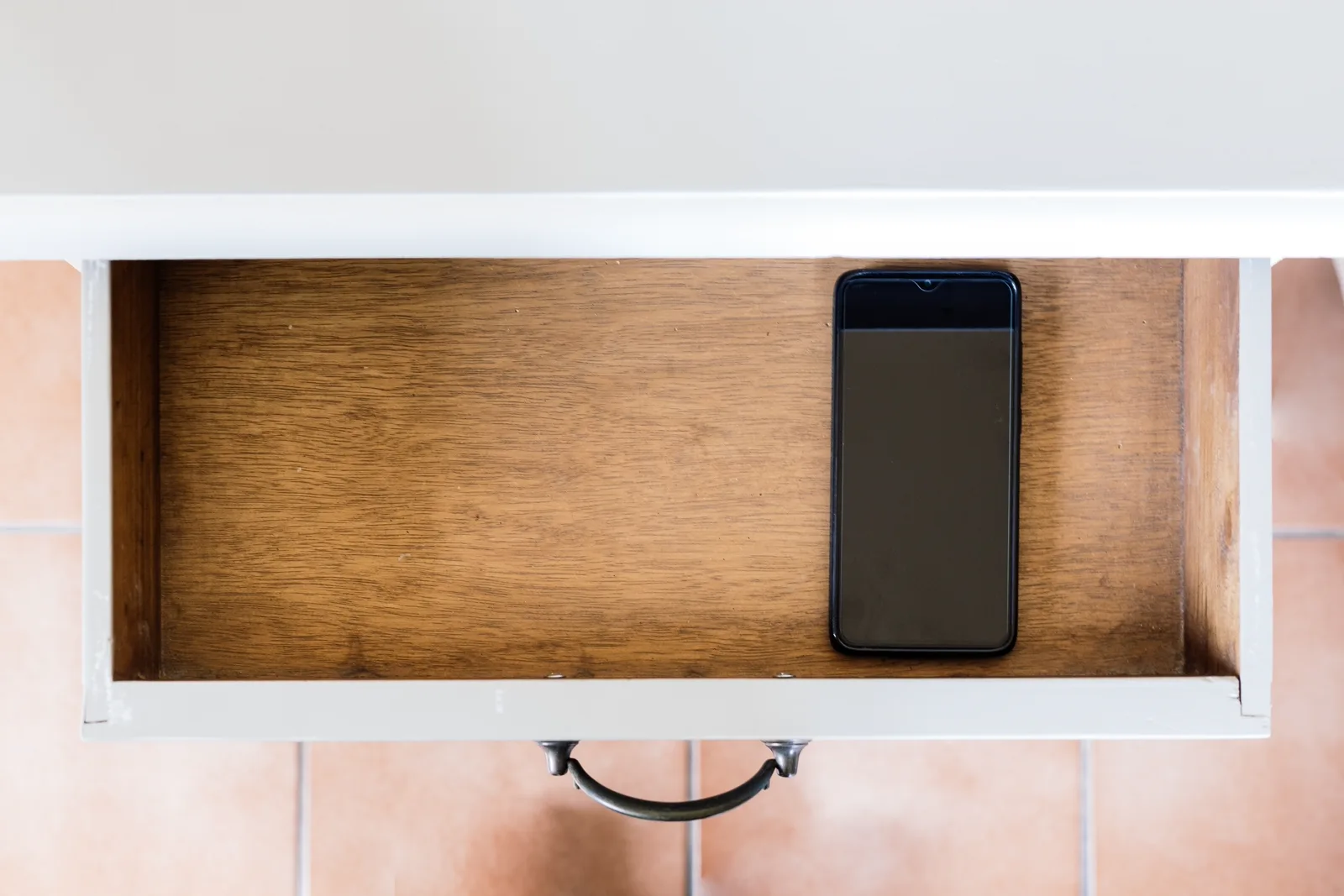
The interventions with the highest hit rate in adult populations are structural rather than psychological. Grayscale mode (which reduces the dopaminergic pull of color-saturated feeds). Deleting an app from the phone entirely and using the web version on a laptop (10x more friction for short scroll sessions). Removing the phone from the bedroom. Putting the phone in a drawer during deep work. Each one of these moves the equation by changing the cost of use, not by adding willpower demands on top.
Replace, don't subtract
The single most reliable failure mode in adult screen reduction is "I'll just have less phone time" without specifying what the time becomes. The vacuum gets refilled by the phone within days. The interventions that hold pair a removal with a specific substitution: phone out of the bedroom plus a book on the nightstand; no phone at breakfast plus a real coffee ritual; no phone during work-day lunch plus a 20-minute walk. The replacement is the reduction.
The 5/2 week (or just the weekend)
Many adults find a five-day on / two-day off structure easier to hold than a daily target. The weekend phone gets used differently. A specific time window with no scroll apps available. A walk or hike with the phone in a backpack. Or the full version: a single screen-off weekend day per week, with the family or partner on board. The on/off rhythm is closer to how people actually live than a 30-percent-every-day reduction.
Single-tasking practice
Not strictly a screen reduction technique, but the highest-leverage compounding upgrade adjacent to it. Pick one daily ritual and do it without the phone present. Walking the dog. The first cup of coffee. Cooking dinner. Showering. The point isn't the activity, it's the rebuilding of the attention muscle for sustained single-task focus, which has measurably atrophied for most adults since the smartphone became standard. Two weeks of one daily single-tasked ritual produces a measurably different relationship with the phone.
The 30-day digital minimalism reset (Newport 2019)
Newport's version of the structural reset: delete all optional apps for 30 days. Reintroduce only the ones you genuinely miss for a defined reason. Most adults who run the exercise reintroduce dramatically fewer apps than they expected. The 30 days is doing two things at once: recalibrating the dopaminergic baseline (which takes about 14 days at minimum) and giving you 16 more days of life-without-the-app to honestly compare against. After the recalibration, "I scroll because I'm bored" tends to read very differently than it did on day one.
The dumbphone and minimalist phone movement
For a meaningful minority of adults, the structural approach scales further. The Light Phone, Wisephone, Nokia revival models, and a quiet uptick in feature-phone adoption among adults in their 20s through 40s have moved this from a fringe move to a recognized option. The mechanism is geographic and physical, not psychological. The device that can't load TikTok is the device that doesn't load TikTok.
The full switch isn't required to get most of the benefit. Many adults run a hybrid: smartphone for daytime, feature phone or grayscale-only second phone for evenings and weekends. Others use the smartphone but delete all browsers and social apps from it, treating it as a phone-and-maps device. The cost-benefit math is different for everyone, but the experiment is unusually accessible. A $100 feature phone for one month is one of the lowest-stakes screen-reduction experiments available.
The pause that does the work
Pax Gate is a mindful app blocker built around a different idea than most. Instead of a hard lockout, it puts one small pause in front of the apps you scroll without thinking. The pause turns into a gratitude prompt, a quick reflection, or a mood check. Three seconds, not a fight. The apps you actually want to use are still there. The apps you reach for without thinking now ask you a question first.
Join the Pax Gate waitlist The mindful pause is the mechanism the digital minimalism research keeps pointing at. The friction is the feature.See what your hours are actually costing
The Screen Time Cost Calculator gives you a personalized estimate of what your phone time is costing in hours, sleep, focus, and money. The Trade Calculator above shows what you could be doing with the hours. This one shows what you're paying for them.
Try the Screen Time Cost CalculatorWhen adult screen use crosses into a problem
Most adults who land on this page aren't in problem territory. They're in heavy-use territory, which is something different and is what most of this guide is about. A subset are using in a way that meets the clinical pattern of compulsive use: distress when separated from the device, use that's interfering with work or relationships in a way they've already tried and failed to address, use as a primary emotion regulator (the phone is what you reach for whenever you feel anxious, lonely, or low). If three or more of these are present, this is worth treating as a behavioral health situation rather than a self-discipline situation. The screen addiction guide goes into the clinical picture in more depth.
If we are being real, the line between heavy use and compulsive use is fuzzier than the framing suggests. Most adults are somewhere on a spectrum. The Trade Calculator above is one useful self-test: if you can identify several years of goals you've held but haven't moved on, and the time math suggests the screen hours are most of the missing time, the trade is genuinely available. If the screen hours feel like they're consuming time you actively don't want them to, it's worth taking that signal seriously rather than dismissing it as a character flaw.
The version that actually holds
Across the behavioral change literature and across the lived experience of adults who've done this work, three things separate the reductions that hold from the ones that collapse. Clarity about what you're trading for, because vague reductions get reclaimed; specific replacements get protected. Structural changes before psychological ones, because willpower runs out and friction doesn't. A unit of time short enough to actually finish, because "I'll be off social media forever" is a much harder commitment than "I'll do the 30-day reset and reassess." The 30-day frame is what most successful adult reductions are built around. After 30 days, you know enough to decide what comes next.
Related guides and tools
FAQ
How much screen time is too much for an adult?
The 2024 Common Sense Media adult census put the average non-work screen time for US adults at 4 hours and 25 minutes per day, with the top quartile above 7 hours. Most adults who land on this page are in the 3-to-6-hour band and aren't worried about the number itself. They're worried about what they're trading for it. Sleep, attention, relationship presence, and the identity question of who you become when you spend 1,200 hours a year on a screen.
What is the most effective single change for reducing adult screen time?
Removing the phone from the bedroom. The 30 to 90 minutes most adults spend on the phone in bed is the most concentrated stretch of low-value screen time in a typical day. The change requires a $20 alarm clock and a charging spot elsewhere in the house. Most adults find this one change cascades into shorter overall screen days, better sleep, and a different morning state of mind.
How long does it take to reduce screen time as an adult?
The behavioral change literature is reasonably consistent. Most adults who hold a reduction for 3 to 6 weeks stop missing the volume of use they cut, and the reduction becomes the new baseline. The most-cited intervention study (Hunt et al. 2018 at Penn) ran 3 weeks at 30 minutes per day per platform and produced measurable drops in depression and loneliness. The first 10 to 14 days are the hardest; the dopamine baseline takes that long to recalibrate.
Does phone use really hurt relationships?
Yes, in a way that's clearer in the research than most people realize. Misra et al. (2014) ran the "iPhone Effect" experiment showing that conversations with a phone visible on the table (not in use) were rated as measurably less close, less empathetic, and less satisfying. Przybylski and Weinstein (2013) replicated it. David and Roberts (2017) documented the effect in couples and coined the term "phubbing." The phone doesn't have to be in active use. It just has to be visible.
What is digital minimalism?
Cal Newport's 2019 framing of an idea that's since gone mainstream: rather than reducing screen time by willpower, audit your digital tools the way you'd audit your closet. Keep only the ones that produce real value for the life you actually want. The minimum effective version is a 30-day reset where you delete optional apps, then reintroduce only the ones you genuinely miss for a defined reason. Most adults reintroduce fewer apps than they expected.
Are dumbphones or minimalist phones worth it?
For a meaningful minority of adults, yes. The Light Phone, Wisephone, Nokia revival models, or a feature phone for evenings and weekends are real options that a growing number of adults find effective when willpower-based approaches haven't worked. The mechanism is structural rather than psychological. The full switch isn't required to get most of the benefit; many adults use a feature phone or grayscale-only second phone for evenings, weekends, or sabbatical periods.
How do I reduce screen time when most of my work is on a screen?
Separate work and leisure cleanly. Work screen time is largely non-negotiable for most knowledge workers; that's a job-design conversation, not a screen-time one. Leisure screen time is where the lever is. Most adults are inside a typical day with 8 hours of necessary work screens and 3 to 5 hours of leisure screens. The leisure block is the addressable surface, and almost all of the relationship, sleep, identity, and presence costs are concentrated there.
What if I keep starting and stopping?
Common, and not as much of a problem as it feels. The reduction that holds isn't the one you never break; it's the one you keep returning to. The behavioral-change pattern is closer to a slow-drift average than a clean cutover. If the trend across months is downward and the new baseline is lower than the old one, the reduction is working even if individual weeks look messy. Track the rolling 4-week average rather than week-to-week.
Sources
- Chang, A. M., Aeschbach, D., Duffy, J. F., & Czeisler, C. A. (2015). Evening use of light-emitting eReaders negatively affects sleep, circadian timing, and next-morning alertness. Proceedings of the National Academy of Sciences, 112(4).
- Common Sense Media. (2024). The Common Sense Census: Media Use by Adults in America.
- David, M. E., & Roberts, J. A. (2017). Phubbing: The dark side of smartphones. Computers in Human Behavior, 75, 109-115.
- Hunt, M. G., Marx, R., Lipson, C., & Young, J. (2018). No more FOMO: Limiting social media decreases loneliness and depression. Journal of Social and Clinical Psychology, 37(10), 751-768.
- Leroy, S. (2009). Why is it so hard to do my work? The challenge of attention residue when switching between work tasks. Organizational Behavior and Human Decision Processes, 109(2), 168-181.
- Mark, G., Gudith, D., & Klocke, U. (2008). The cost of interrupted work: more speed and stress. Proceedings of CHI 2008.
- Misra, S., Cheng, L., Genevie, J., & Yuan, M. (2014). The iPhone effect: The quality of in-person social interactions in the presence of mobile devices. Environment and Behavior, 48(2).
- Newport, C. (2016). Deep Work: Rules for Focused Success in a Distracted World. Grand Central Publishing.
- Newport, C. (2019). Digital Minimalism: Choosing a Focused Life in a Noisy World. Portfolio.
- Przybylski, A. K., & Weinstein, N. (2013). Can you connect with me now? How the presence of mobile communication technology influences face-to-face conversation quality. Journal of Social and Personal Relationships, 30(3).
One last thing
The version of this article that pretends adult screen reduction is a heroic achievement is the version that doesn't work. It isn't. It's a trade, and the trade is good. 547 hours back in a year is real, and 547 hours is enough for almost any goal an adult holds quietly enough that they haven't given themselves permission to want it out loud. Pick one, run the Trade Calculator, and let the number do its own arguing. The phone will still be there on day 31, if you want it back. Most people who do the work don't.