
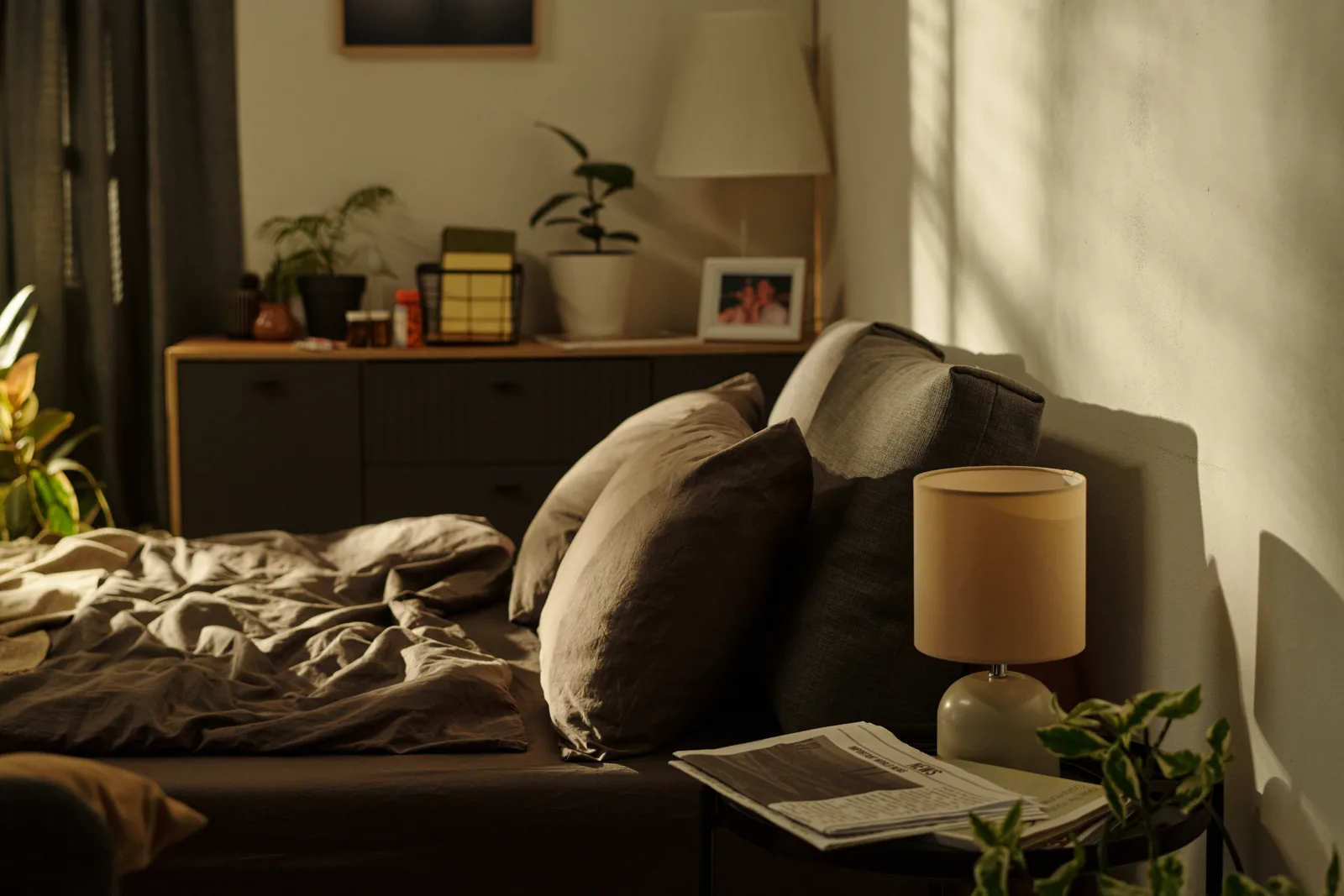
Why before-bed is the highest-leverage screen reduction in the day
Most screen-reduction questions are slow. The behavior is spread across the day, the benefits are diffuse, the feedback is delayed. The before-bed version is the opposite of all three. It's one specific window. The benefits are concentrated (sleep onset, sleep quality, morning state). The feedback comes in days, not months. If we are being real, this is the version of screen reduction with the best ratio of effort to result for most adults.
Three things separate the before-bed conversation from general screen reduction. The first is that the research base is unusually strong. Chang et al. (2015) is the cleanest experimental sleep-and-screens study in the literature; we'll walk through it below. The second is that the mechanism is multi-channel: it's not just light, it's content and arousal too, and addressing only one of the three misses most of the effect. The third is that the intervention is exceptionally specific. Most adults can identify the exact 60-to-120-minute window where their phone use is doing the damage, which makes the trade unusually targeted.
The Wind-Down Sequence Builder below is the personalized version. Set your sleep target and your preferred wind-down length, and it generates the minute-by-minute architecture for the evening, with each block tagged for what it's doing biologically. The research underneath the sequence comes next; the bedroom rules and the special cases after that.
The Wind-Down Sequence Builder
Move the sliders, pick where you're starting from, and the builder generates the wind-down for your specific bedtime. The sequence is anchored to the sleep biology research; each block specifies what it's doing biologically alongside what you're doing behaviorally.
Sleep doesn't reward perfectionism. It rewards consistency. A wind-down you actually do five nights a week beats a perfect one you do twice. Pick the version of the sequence that fits your real life.
What the research actually shows about screens and sleep
The sleep-and-screens literature has consolidated meaningfully in the last decade. The findings most relevant to the before-bed question:
Chang et al. (2015) at Harvard
The cleanest experimental study in this space. Participants spent two weeks reading either a paper book or a light-emitting eReader for 4 hours before bed. The eReader nights produced a 90-minute delay in melatonin onset, reduced REM sleep, and measurably reduced next-morning alertness. This is THE study every screens-and-sleep article references; the effects are large enough to dominate most other variables.
Carter et al. (2016) and Hale & Guan (2015)
Two large reviews looked across the screens-and-sleep literature for children, adolescents, and adults. The consistent finding: screen use within an hour of bed is associated with delayed sleep onset, shorter total sleep duration, and lower self-reported sleep quality. The effect was largest for portable touchscreen devices held in the hand close to the face, which is exactly the pattern most adults use in bed.
Exelmans & Van den Bulck (2016)
One of the cleaner adult-specific studies. A representative sample of Belgian adults: bedtime phone use predicted poorer sleep quality, longer sleep onset, and more daytime fatigue, after controlling for age, gender, and a long list of demographics. The relationship held across light users, moderate users, and heavy users, with the dose-response showing a clean monotonic pattern.
The three channels are independent
Tähkämö, Partonen, & Pesonen (2019) and others have separated the mechanisms. Light: short-wavelength (blue) light suppresses melatonin production in a dose-dependent way. Content: algorithm-driven feeds extend session duration, pushing the moment of putting down. Arousal: emotionally engaging content (good or bad) elevates cognitive arousal at the wrong time. Addressing only one channel (say, the iPhone Night Shift mode) catches the light effect but misses the content and arousal effects, which is why "I have blue light filter on, it should be fine" tends not to hold up in practice.

The three bedroom rules that hold
If you don't read anything else on this page, this is the version. Three rules. Each one is independently supported by the research; together they cover most of the addressable surface.
The version of the answer that disappoints people: there isn't really a fourth rule. These three cover most of the research, most of the lived experience, and most of the change most adults need. Almost everything else on this page is operationalization of these three. The wind-down sequence is "no screens in the last hour" with structure. The morning rule is downstream of "phone outside the bedroom." The middle-of-the-night rule is the version of "no screens in bed" that handles 3 AM.
The architecture of a wind-down hour
The Wind-Down Sequence Builder above generates personalized timings. The general architecture, which is what those timings are derived from, follows roughly this pattern across most adults.
The cutoff (T-90 to T-60 minutes)
Phone goes on the charger in another room. This is the single most important moment in the wind-down. Everything downstream depends on it. Set up tomorrow (clothes, coffee, the morning's first thing) so the wind-down is also a small forward investment, not just a removal.
Dim and low-stim (T-60 to T-15 minutes)
Main lights down (warm bulbs, lamps, candles in winter). Choose a low-stimulation activity: paper book, audiobook, conversation with a partner, journaling, light stretching or a short bath. Avoid: news, intense fiction, work emails, anything that elevates emotional arousal. The point is not boredom; the point is sustained low arousal, which is the state your circadian system is trying to produce on its own and which screens directly oppose.
Bathroom and bed (T-15 to T-0)
Quick. Don't relight bright lights. Bathroom, teeth, skincare in dim light if possible. Into bed. The 10 minutes here is the runway, not the journey; treat it as practical, not a second wind-down phase.
In bed (T-0 onward)
Lights off, or a single low-light reading lamp for a maximum of 10 minutes of paper-book reading. Eyes closed; let the day fall off. Most adults who hit phases 1 through 3 well find phase 4 takes care of itself within a couple of nights.
What to actually do in the wind-down
The vacuum problem is real. "Don't use the phone for an hour before bed" without specifying what fills that hour tends to last 3 to 5 nights before the phone refills the space. The replacements that hold for most adults, in rough order of how well they work in the wind-down window:
- Read a paper book. The highest-yield single replacement. Most adults underestimate how quickly the habit returns once the phone is out of the picture. Keep a book on the nightstand, even if it took years off your previous reading life. Most former readers report being back to a book a week within a month of the wind-down change.
- Audiobook or podcast on a dedicated speaker. Not on a phone (the bedside speaker matters: phone in the room defeats the geographic intervention). The right type of content matters: avoid news, true crime, anything that creates rumination loops at sleep onset.
- Conversation with a partner. The lost art. The 30 minutes before sleep used to be one of the highest-quality relationship windows in the day; for many couples, it now isn't. Reclaiming it is one of the meaningful side benefits of the wind-down.
- Journaling. Useful for the kind of mind that runs anxious loops at sleep onset. A "tomorrow's three things" list or a brief gratitude entry off-loads the running loop. Doesn't need to be elaborate; the act of putting words on paper does most of the work.
- A short stretch, a bath, or skincare you didn't make time for. Body-focused activities lower cognitive arousal naturally. Most adults find one of these three becomes a quiet anchor of the new evening.
- Just sitting in lower light. Underrated. The simple act of sitting in a chair in dim light, no input source running, does the wind-down work the sleep system is asking for. The boredom of the first night is the recalibration happening in real time.

The 3 AM rule (what to do when you wake)
Most adults wake at least once per night. The version of this question that matters: what do you do when you do? The wrong answer, well-documented in the sleep-disturbance literature, is to pick up the phone. Bright light at 3 AM signals to the circadian system that morning has arrived; the melatonin pulse that would have gotten you back to sleep gets suppressed; the next 60 to 90 minutes get noticeably harder. One nightstand-phone check turns a brief waking into an hour of lost sleep.
The version that works, in the sleep research and in practice: if you can't get back to sleep within about 20 minutes, get up, leave the bedroom, go to another room with very dim warm light, and do a low-stim activity (read a paper book, sit in a chair, list tomorrow's tasks in your head) until you feel sleepy again. Then return to bed. No phone at any point. This protocol (a version of stimulus control therapy for insomnia) is one of the most evidence-supported middle-of-the-night interventions in the entire sleep medicine toolkit, and the phone-free clause is structurally non-negotiable.
The morning effect (good sleep makes daytime reduction easier)
One of the less-discussed feedback loops in screen reduction: poor sleep makes the next day's phone use harder to manage. Sleep-deprived people have measurably lower impulse control, lower frustration tolerance, and higher dopaminergic reward-seeking. The same person who can put the phone down at 2 PM after 8 hours of sleep struggles to put it down at 2 PM after 5 hours. The before-bed intervention is, in this sense, the structural foundation for the rest of the day's screen reduction. Most adults who hold the wind-down for two weeks report that their general phone use drops as a side effect, even when they aren't actively trying to reduce it.
This is one of the reasons the before-bed intervention has unusually fast feedback. The first week's improvement in sleep is its own reward; the second week's improvement in daytime focus and mood is the compound benefit. By the third week, most people aren't sustaining the change by willpower anymore. The change is sustaining itself, because the version with the phone in the bed has become noticeably worse in comparison.
The pause that doesn't argue with you
Pax Gate is the app blocker we built around a different idea than most. Instead of a hard lockout, it puts one small pause in front of the apps you scroll without thinking. The evening setting is the version most useful here: turn the pause on for the last 90 minutes before your target sleep time, and the apps you'd reach for unconsciously now ask you a question first. Three seconds, not a fight.
Join the Pax Gate waitlist The phone doesn't go away. It just stops being the thing you reach for at 10:47 PM without remembering why.See what your phone time is actually costing
The Screen Time Cost Calculator gives you a personalized estimate of what your phone time is costing in hours, sleep, focus, and money. The sleep section is especially relevant here.
Try the Screen Time Cost CalculatorEdge cases (partner, kids, shift work)
When a partner wants to scroll in bed and you don't
Genuinely common, and worth addressing directly. The version that holds, in lived practice, isn't a moral argument. It's the brightness of the screen. A bright phone in a dark bedroom is light pollution for the non-using partner regardless of what they prefer. The compromise that works for most couples: phones can stay in the room with brightness all the way down, in airplane or do-not-disturb mode, and facing away from the partner. The full version (both phones out of the bedroom, a real alarm clock) is the higher-leverage move when both partners are willing, and the second person tends to come along once the first has done it for two weeks.
When kids' bedtimes overlap with yours
The structural answer is to use the period when the kids are awake as adult wind-down setup time, not adult phone time. Most parents who use the kid-bedtime hour to scroll find themselves restarting the wind-down once the kids are down, which is why "I didn't get to wind down" becomes a daily reality. The version that works: the parent wind-down starts when the kid wind-down starts, on a shifted schedule (parent target sleep 30 to 60 minutes after youngest kid). The hour after the kids are asleep gets used differently when the adult wind-down is already underway.
Shift work, on-call, or other genuine constraints
Some adults legitimately can't follow the standard architecture. Night-shift workers, parents of infants, on-call medical or technical staff, partners of people in those categories. The research base on shift work is its own subfield; the headline finding is that consistent sleep timing matters more than absolute alignment to night. If you work 6 PM to 2 AM, the wind-down architecture still applies; the times just shift. T-90 starts at 12:30 AM, blackout shades during the day, the same three bedroom rules, the same content rules. The phone-not-in-bed rule applies regardless of shift.
What to expect in the first two weeks
The behavioral change pattern is reasonably consistent across adults who run this protocol. The shape of it:
- Nights 1 to 3: The hardest. The cognitive and dopaminergic recalibration takes a few cycles. Expect the wind-down to feel longer than expected; expect the urge to check the phone to be most intense around T-30 (the witching hour for adult phone habits). The first 3 to 5 nights are the proof-of-concept; getting through them is most of the work.
- Nights 4 to 7: Sleep onset drops measurably. Most adults at this point report falling asleep faster than they have in years, and waking less in the middle of the night. The wind-down activity (book, conversation, etc.) starts to feel like its own thing, not a phone replacement.
- Nights 8 to 14: The full benefits land. Morning state is noticeably different. Daytime focus improves as a side effect. The version with the phone in the bed starts to feel actively unappealing rather than required.
- After day 14: The change is sustaining itself. The wind-down isn't a discipline practice anymore; it's the new shape of the evening. Most adults who hold it past 14 days never return to the previous pattern.
Related guides and tools
FAQ
How long before bed should I stop using screens?
The research-anchored answer is 60 to 90 minutes. Chang et al. (2015) found that evening use of light-emitting devices delayed melatonin onset by about 90 minutes. The 60-minute cutoff is the realistic version most adults can hold and produces most of the benefit. Any quick check after the cutoff tends to delay sleep onset by more than the check would suggest, because of how dopaminergic content and arousal carry over into the lying-down window.
Does the phone really keep me awake?
Yes, in three ways. The light suppresses melatonin (Chang 2015). The content (algorithm-driven feeds) extends session time and pushes back the moment of putting down. The arousal (whether good content or bad content) elevates cognitive arousal when the body is trying to do the opposite. Addressing only one channel (like blue-light filter) catches one effect but misses the other two, which is why filter-only solutions tend not to hold up in practice.
What is the best wind-down routine before bed?
The shape most sleep researchers recommend: T-90 to T-60 (phone out of room, dim main lights, set up tomorrow), T-60 to T-15 (low-stim activity like paper book or conversation), T-15 to T-0 (bathroom, teeth, into bed), T-0 onward (lights off or 10 minutes max of low-light paper reading). The Wind-Down Sequence Builder above generates this for your specific sleep time.
What about reading on a Kindle?
Kindle Paperwhite and similar e-ink devices emit less blue light than LCD or OLED phones. The clean rule: paper is best, front-lit e-ink with warm light and low brightness is acceptable, phones and tablets in normal mode are the worst. If e-ink is what gets you reading instead of scrolling, the trade is almost certainly worth it.
What do I do if I wake up at 3 AM?
Don't pick up the phone. Bright light at 3 AM signals to the circadian system that morning has arrived, suppressing the melatonin pulse that would have gotten you back to sleep. If you can't fall back asleep within about 20 minutes, get up, go to another room with very dim warm light, do something low-stim until sleepy, then return to bed. No phone at any point.
Should the phone be in the bedroom at all?
For most adults the cleanest version of the answer is no. A $20 alarm clock removes the only legitimate argument for the phone on the nightstand. If you need the phone in the bedroom for legitimate reasons (oncall, vulnerable family member), the next-best version is phone face-down across the room, do not disturb on, no nightstand placement. What matters is whether the phone is reachable from bed.
How long does it take to see results?
Most adults notice changes within 3 to 7 days; full circadian benefits typically arrive within 14 days. The first 3 to 5 nights feel longer (recalibration). By day 14 the difference is usually substantial enough that the old habit feels obviously worse in retrospect. This is one of the fastest-feedback behavioral changes available.
What if my partner wants to scroll in bed and I don't?
Common. The version that holds isn't a moral argument; it's the brightness of the screen. A bright phone in a dark bedroom is light pollution regardless of preference. Compromise: phones in the room with brightness all the way down, airplane or do-not-disturb mode, facing away from the partner. The full version (both phones out of the bedroom) is higher-leverage when both are willing, and the second partner tends to come along once the first has done it for two weeks.
Sources
- Carter, B., Rees, P., Hale, L., Bhattacharjee, D., & Paradkar, M. S. (2016). Association between portable screen-based media device access or use and sleep outcomes: A systematic review and meta-analysis. JAMA Pediatrics, 170(12).
- Chang, A. M., Aeschbach, D., Duffy, J. F., & Czeisler, C. A. (2015). Evening use of light-emitting eReaders negatively affects sleep, circadian timing, and next-morning alertness. Proceedings of the National Academy of Sciences, 112(4).
- Exelmans, L., & Van den Bulck, J. (2016). Bedtime mobile phone use and sleep in adults. Social Science & Medicine, 148, 93-101.
- Gradisar, M., Wolfson, A. R., Harvey, A. G., Hale, L., Rosenberg, R., & Czeisler, C. A. (2013). The sleep and technology use of Americans: Findings from the National Sleep Foundation's 2011 Sleep in America Poll. Journal of Clinical Sleep Medicine, 9(12).
- Hale, L., & Guan, S. (2015). Screen time and sleep among school-aged children and adolescents: A systematic literature review. Sleep Medicine Reviews, 21, 50-58.
- Tähkämö, L., Partonen, T., & Pesonen, A. K. (2019). Systematic review of light exposure impact on human circadian rhythm. Chronobiology International, 36(2).
- Walker, M. (2017). Why We Sleep: Unlocking the Power of Sleep and Dreams. Scribner.
One last thing
If you only do one thing on this page, do the first rule. The phone charges in another room. Tonight. A $20 alarm clock arrives by tomorrow if you don't already have one. Almost everything else in this guide is downstream of that single change, and the change is so simple it can be done in the next 90 seconds. Most adults who run only this one intervention report a measurably different next morning, and a meaningfully different week. The rest of the wind-down is what you build on top of that foundation. The foundation itself takes less time to set up than it took to read this paragraph.