
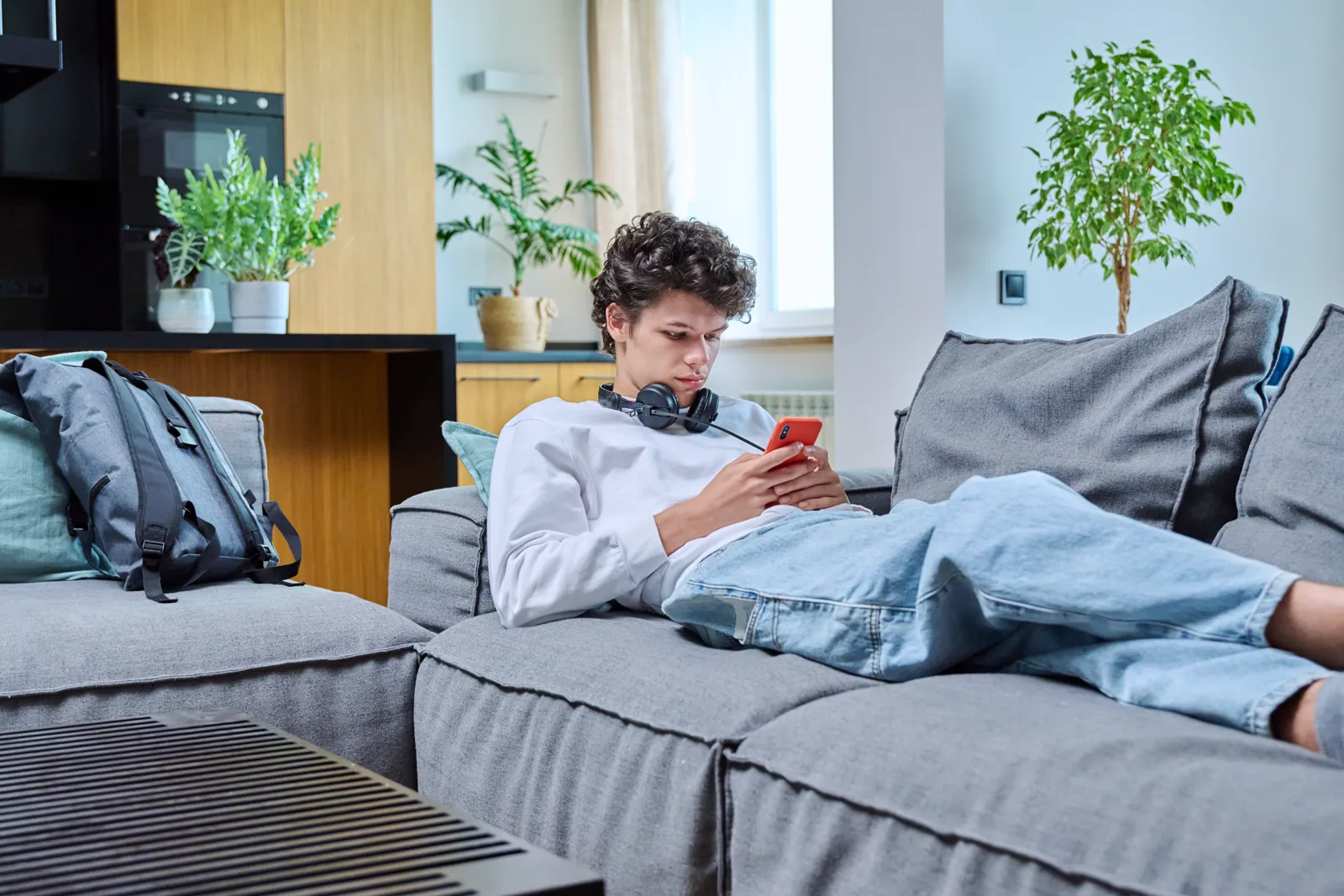
Why this is different than reducing screen time for kids
Most parents who land on this page have already tried the strategies that worked when the kid was 9. Family kitchen-counter parking. Strict limits on minutes per day. Open phone checks. Confiscation as discipline. The strategies didn't suddenly stop working because the parents got worse. They stopped working because the kid changed.
Three things separate adolescent screen use from school-age screen use, and each one breaks an assumption the older rules were built on. The phone is now social infrastructure: removing it means real social isolation, not just inconvenience. Identity development happens partly through the phone for current teens: blocking access to social platforms isn't only a behavior change, it's an identity change. And teens have a different relationship to autonomy: imposed limits at 14 produce strategic compliance and resentment in roughly equal proportions, where at age 9 they mostly just produce compliance.
If we are being real, none of that means the screens are fine. It means the toolkit has to be different. What follows is the toolkit for this age range. The diagnostic below helps you figure out what the actual concern is, since "screen time" is rarely the real worry; the seven strategies further down are the ones that hold with this age; and the conversation guidance at the bottom is what tends to make the difference between a teen who participates in the change and one who works around it.
What's the actual concern? A quick diagnostic
Most parents who arrive at "I need to reduce my teen's screen time" are actually worried about something more specific: sleep, school, mood, or social withdrawal. Naming the underlying concern lets you target the intervention. Move the sliders, check what you've noticed, and the panel rebuilds with what the research says about that specific concern plus the strategies that target it.
The teen years are not the age to win the screen time argument. They're the age to slowly hand control over while the underlying skills are still in development. The goal isn't compliance. The goal is a young adult who can put the phone down when they want to.
What the research actually shows about teens and screens
The popular narrative on adolescent screen time has gotten louder than the research underneath it. The careful version is more nuanced.
The Surgeon General Advisory. The 2023 US Surgeon General Advisory on Social Media and Youth Mental Health is the cleanest current summary. It flagged strong associations between heavy social media use and worse mental health outcomes for teens, especially for girls and especially for users in the top quartile of daily use. The advisory was clear that causation hasn't been definitively established, but the correlation is consistent enough across studies and countries that it warrants treating as actionable.
Hunt et al. (2018) at Penn. The cleanest experimental study. 143 undergraduates were randomized into a control group or a limit group (30 minutes a day across Facebook, Instagram, and Snapchat). The limit group showed measurable drops in depression and loneliness after three weeks. The effect was largest in students who'd been the heaviest users at baseline. This is the closest thing to evidence that reducing helps, rather than just being correlated with less harm.
Orben & Przybylski (2019). The careful counterpoint. Using large datasets, they found that the average effect size of screen time on adolescent well-being is small in cross-sectional data, on the order of "less than wearing glasses." The catch: the effect is much larger for heavy users (top 20 to 25 percent of users), where it becomes substantial. Translation: the average teen isn't dramatically harmed by average use. The heavy users are where the action is.
Twenge (2017, 2023). Twenge's longitudinal work argues that the rise in adolescent depression and anxiety since 2012 tracks the rise in smartphone ownership and social media use. The causal claim is debated; the correlation is well documented. Even researchers who disagree with the causal interpretation tend to agree the change since 2012 is real and worth taking seriously.
The synthesis most adolescent psychiatrists are running with right now: average use isn't catastrophic, but heavy use (top quarter of users) appears to be doing real harm, especially around sleep, social comparison, and time-of-day patterns. Most parents land here because they suspect their teen is closer to that top quartile.
The collaborative approach (and why "because I said so" backfires here)
The single biggest predictor of whether a screen time intervention with a teen actually holds is whether the teen helped design it. Lukianoff and Haidt (2018) and a growing developmental literature converge on this. Imposed limits at age 14 produce three predictable patterns: strategic compliance (use elsewhere, on a school account, at friends' houses), open resistance (the daily fight), and eventually a quiet erosion of trust on the parental side that's worse than the original screen time problem.
The collaborative version of the same conversation has three pieces. Name your actual concern (not "your screen time," but "your sleep has been worse this month and I think the phone is involved"). Invite the teen to be part of the solution. Set the rules together, in writing if it helps, with regular check-ins.
This isn't soft parenting. It's a structural recognition of where you actually have leverage. With a 9-year-old, you can mandate. With a 14-year-old, you can negotiate. With a 17-year-old, you can mostly only model and converse. The earlier the family practices the collaborative version, the better it tends to hold across the rest of adolescence.

Seven strategies that hold with teens
Phone charges outside the bedroom (the whole family)
The single highest-leverage change for adolescent sleep, attention, and morning mood. Charges in the kitchen, including the parents'. The "as a family" framing is what makes it stick; "we're all doing this together" produces dramatically less resistance than a teen-specific rule. Carter et al. (2016) is the strongest evidence base.
No phone at meals (including yours)
One device-free meal a day produces measurable changes in family communication and adolescent reports of feeling heard, across multiple studies. The version that fails is the one where the parents are still half-checking. The version that succeeds treats the meal as protected for everyone.
Negotiate which apps, not just how much
"Reduce screen time" is too abstract for a teen to engage with. "Less Instagram before bed because it's been affecting your sleep" is concrete. The conversation that moves the needle is usually about specific apps and specific contexts, not about totals. Most teens know which app is the actual problem; they just haven't been asked.
Use Apple Screen Time / Android Digital Wellbeing as the data layer
Pull the weekly report up together. Don't comment, just look. The data tends to do the work that lecturing fails to do. Teens often underestimate their own use; seeing the actual numbers in a calm conversation is more effective than parents pointing out the numbers in the middle of a conflict.
Make replacement the focus, not removal
The strongest reductions pair "less phone" with "more of something specific." A sport. A music project. A weekend job. A regular hangout with friends in person. Removing the phone without a replacement creates a vacuum the phone refills. The replacement is the reduction.
Model the behavior you're asking for
Lauricella et al. (2015) and many follow-ups find that the strongest predictor of adolescent screen time is parental screen time. If your phone is in your hand at dinner, the dinner rule is unfair and your teen will say so. Your own use is part of the intervention.
Schedule a quarterly check-in
Every three months, sit down together and look at what's working, what isn't, and what's changed. The check-in itself signals that the rules aren't fixed; they evolve as the teen does. Plans that include this kind of structured revisit hold meaningfully longer than plans that don't.
Conversations that move the needle (and ones that don't)
The screen time conversation in most households happens in the middle of conflict, in the kitchen, while someone is trying to leave for school. Almost none of that is the conversation that actually changes anything. Three versions of the same conversation are worth scheduling outside the conflict.
"What do you actually like about this app?" Genuinely curious, not as a setup. Most teens are using apps for reasons that make sense to them: connection, identity exploration, creative expression, decompression, status. Knowing the actual answer changes the conversation. A teen who's using TikTok for creative inspiration needs a different intervention than one who's using it as a coping mechanism for social anxiety.
"What would you change about your own use if you could?" Many teens have private concerns about their own phone habits that they don't share when the rules feel imposed. Asking, calmly, often produces meaningfully more honesty than telling.
"What's hard about putting it down?" Naming the difficulty is the start of being able to choose differently. If a teen can articulate what they get from the screen and what they lose by putting it down, they're already further along than most adults on the same question.
The version that doesn't work, every time: "You're on that thing too much." It's not new information, it puts the teen on the defensive, and it never leads to a different outcome.
About social media specifically
Most "reduce my teen's screen time" conversations are really social media conversations. The Surgeon General Advisory and the bulk of the recent research focus on this specifically because the active-comparison and identity dimensions of social platforms appear to drive more harm than other forms of screen use.
Three platform patterns parents tend to underestimate. Late-night use: the worst hour-of-day for adolescent mental health appears to be 10 PM to 2 AM use, when alone and tired. Short-video formats (TikTok, Reels, Shorts): the variable-reward design is unusually sticky for the adolescent dopamine system. Algorithmic vs friend-based feeds: feeds dominated by algorithm-selected creators tend to track worse than feeds dominated by actual friends, in self-reports of social comparison.
If your teen is heavy on the late-night, short-video, algorithmic combination, the diagnostic above probably surfaced sleep or mood as a concern. The targeted intervention there is often more useful than a general screen time cut.

When to be more concerned
Most teens are using a lot of screen time and are basically okay. A subset are using a lot of screen time and aren't. Warning signs that the use has crossed from heavy into compulsive include: withdrawal symptoms when separated from the device (irritability, anxiety, restlessness), lying about use, declining academic performance traceable to the device, deteriorating sleep that doesn't improve with the bedroom rule, social isolation worse than baseline, and signs of underlying depression or anxiety that the device may be both medicating and amplifying.
If multiple of these are present, it's worth treating as a behavioral-health situation, not a parenting one. A counselor or adolescent psychiatrist with experience in problematic technology use is the right call. The screen addiction guide covers the clinical side in more depth.
The structural fix for your own phone (and the modeling for theirs)
The single strongest predictor of adolescent screen time is parental screen time. Pax Gate is the mindful app blocker we built for the adult side of the same problem. One small pause sits in front of the apps you scroll without thinking, and the pause turns into a gratitude prompt, a quick reflection, or a mood check. Your own use comes down, and your teen sees you putting yours down at the times you've asked them to put theirs down.
Join the Pax Gate waitlist Modeling is the strongest lever you have with teens. It works in the background while everything else gets debated.See what your own screen time is actually costing you
Before the family conversation, the Screen Time Cost Calculator gives you a personalized estimate of what your phone time is costing you. Time, sleep, focus, and money. A useful baseline to bring into the talk.
Try the Screen Time Cost CalculatorRelated Pax Guides and tools
- How to reduce screen time: the general adult version, with the Reduction Roadmap framework.
- How to reduce screen time for kids: for 6 to 12 year olds, where imposed rules still work.
- How to reduce screen time before bed: the late-night window in detail, for any age.
- Screen addiction: the clinical version, with a self-check for the higher-end use patterns.
- Is addiction hereditary: useful context if substance or behavioral addiction runs in the family.
FAQ
How much screen time is too much for teens?
There isn't a single threshold that fits every teen, and the research is clearer on what's being displaced than on what number is fine. Common Sense Media's 2021 census found that teens 13 to 18 averaged 8 hours and 39 minutes a day of total screen media. Most adolescent psychiatrists treat anything that's measurably displacing sleep, in-person friendship, school performance, or physical activity as too much for that specific teen, regardless of what other teens are doing. Two hours of intentional social maintenance plays differently than five hours of passive scrolling, even if both register as the same on a screen time report.
How do I reduce my teenager's screen time without a fight?
The strategies that hold with teens are collaborative, not imposed. Imposed limits at 14 produce strategic compliance and resentment. Three things help: name what you're worried about (sleep, school, mood) instead of arguing about the number; co-design the rules in a calm sit-down, not the moment of conflict; and model your own phone behavior. The research base for the collaborative approach with this age group is strong (Lukianoff & Haidt 2018; Lauricella et al. 2015 on parent modeling). The "because I said so" approach is the one that backfires hardest with teens.
Is social media bad for teenagers?
The research is more nuanced than the headlines suggest. The 2023 US Surgeon General Advisory flagged strong associations between heavy social media use and worse adolescent mental health, especially for teen girls. Hunt et al. (2018) found that limiting use to 30 minutes a day for 3 weeks produced measurable drops in depression and loneliness. At the same time, Orben & Przybylski (2019) found that the average effect size of screen time on adolescent well-being is small in cross-sectional data; the effect is much larger for heavy users (the top 20 to 25 percent), where it's substantial. Translation: social media isn't uniformly bad, but heavy use of certain platforms appears to be.
Should I take my teen's phone away?
Confiscating a teen's phone tends to be useful as a structural change (no phone in the bedroom at night, no phone during family meals) and counterproductive as a punishment. The phone is social infrastructure for current teens; removing it as discipline isolates them in ways that produce more conflict than they solve. The most effective version is removing the device from specific contexts (bedrooms, mornings, meals), not from their lives.
What is the truth behind teens and phone addiction?
The clinical literature treats problematic smartphone use in teens as a real pattern, with prevalence estimates in the 10 to 25 percent range depending on the study and the threshold. Sohn et al. (2019) meta-analyzed 41 studies and found a clear association with depression, anxiety, sleep disturbance, and lower academic performance. The 2023 Surgeon General Advisory is the cleanest summary of the current scientific consensus. If we are being real, most teens don't meet a clinical threshold but use enough that the displacement effects matter.
At what age should a teen get a smartphone?
The Wait Until 8th movement and Jonathan Haidt's recent work argue for delaying smartphones until 14 and social media until 16. There's growing peer-effect data supporting this, since "all my friends have one" loses its force when an entire grade level waits. AAP guidance is less prescriptive but emphasizes that no age is a single threshold; the right age depends on the kid, the family, and the support system around the device once it arrives.
How do I get my teen to put their phone down at night?
The phone-out-of-the-bedroom rule is the highest-leverage adolescent sleep intervention in the literature. Carter et al. (2016) meta-analyzed 20 studies and found measurable sleep effects from screen use within an hour of bedtime. The practical version: a family charging station in the kitchen, including the parents' phones, with all devices docked by 9:30 PM. Built in as a family routine rather than a teen-specific rule, it generates much less resistance. A $20 alarm clock on the nightstand removes the only legitimate argument for the phone being there.
Will reducing screen time improve my teen's mental health?
In the strongest study available (Hunt et al. 2018 at Penn), limiting social media use to 30 minutes a day for 3 weeks produced measurable drops in depression and loneliness in college-age young people. The effect was largest in students who'd been the heaviest users at baseline. For teens, the 2023 Surgeon General Advisory is more cautious about causation but firmer about the correlation: heavy social media use is consistently associated with worse mental health outcomes for adolescents. Reducing won't fix everything, but it tends to help most when the starting point was heavy.
Sources and further reading
- Carter, B., Rees, P., Hale, L., Bhattacharjee, D., & Paradkar, M. S. (2016). Association between portable screen-based media device access or use and sleep outcomes: A systematic review and meta-analysis. JAMA Pediatrics, 170(12), 1202-1208.
- Common Sense Media. (2021). The Common Sense Census: Media Use by Tweens and Teens.
- Hunt, M. G., Marx, R., Lipson, C., & Young, J. (2018). No more FOMO: Limiting social media decreases loneliness and depression. Journal of Social and Clinical Psychology, 37(10), 751-768.
- Lauricella, A. R., Wartella, E., & Rideout, V. J. (2015). Young children's screen time: The complex role of parent and child factors. Journal of Applied Developmental Psychology, 36, 11-17.
- Lukianoff, G., & Haidt, J. (2018). The Coddling of the American Mind. Penguin Press. (Foundational for the collaborative-limits framing.)
- Orben, A., & Przybylski, A. K. (2019). The association between adolescent well-being and digital technology use. Nature Human Behaviour, 3(2), 173-182. (The careful counterpoint to the strong-effect narrative.)
- Sohn, S. Y., Rees, P., Wildridge, B., Kalk, N. J., & Carter, B. (2019). Prevalence of problematic smartphone usage and associated mental health outcomes amongst children and young people: A systematic review, meta-analysis and GRADE of the evidence. BMC Psychiatry, 19, 356.
- Twenge, J. M. (2017). iGen. Atria Books.
- Twenge, J. M. (2023). Generations. Atria Books.
- US Surgeon General. (2023). Social Media and Youth Mental Health Advisory.
- Wait Until 8th (peer-group movement for delaying smartphones until 8th grade).
- Pax Gate companion guides: How to reduce screen time (adult version), How to reduce screen time for kids (6 to 12), and Screen addiction (clinical context).
One last thing
The teen years are not the time to win the screen time argument. They're the time to set the conditions under which a young adult eventually becomes capable of putting the phone down on their own. The structural changes matter; the conversations matter more; the modeling matters most. By the time your teen is 18, you can't impose any of this. The work you do now is the work of building someone who, around age 22, looks at their phone and decides for themselves.