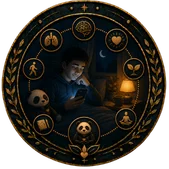

The Feel-Worse Decoder
Pick the feeling a long scroll most often leaves you with. The decoder names the exact mechanism doing it to you, because "social media is bad for you" is too vague to act on, and gives you the specific counter for that feeling.
Here is the reassuring part. If a feed can reliably push your mood down, then changing the feed can let it come back up. The feeling is real, but it is also reversible, and it is not coming from inside you.
The core reason: your brain treats a feed like a place
Underneath every one of those feelings is a single mismatch. Your brain evolved to read your immediate surroundings and respond to them, and it never got the memo that a feed is not a place. So when you scroll, some part of you responds to the stream of content as though it were your actual environment, as though these were your problems, your dangers, your neighbors, your standards. It is not. It is a curated, algorithmically sorted sample of the entire world's worst moments and best highlight reels, delivered faster than any real environment ever could.
That is the root of it. You are asking a stone-age threat-and-belonging system to make sense of a firehose it was never built for, and the feelings, anxiety, anger, numbness, inadequacy, are what that system produces when it is overwhelmed by inputs it cannot act on. Which mechanism dominates depends on what the feed served you and how your particular wiring reacts, which is what the decoder sorts out.
Negativity bias: why it skews dark even when your day is fine
One mechanism deserves its own section because it underlies so many of the others: negativity bias. Your brain is wired to notice, prioritize, and remember negative information more than positive, a survival feature, since historically the person who paid attention to the threat lived longer than the one who stopped to admire the view. "Bad is stronger than good," as one landmark review put it. On a feed, this has an ugly consequence: the alarming, enraging, and distressing items are precisely the ones that grab and hold your attention, so they are what you consume most and remember longest.
The result is a systematically distorted picture. You could scroll past a hundred neutral or pleasant items and one disaster, and it is the disaster that sets your mood and lingers in your memory. Multiply that across a long scroll and you end up feeling like the world is far darker than it is, not because you are pessimistic, but because your attention was captured by the darkest slice of everything on offer.
The best moment to protect your mood is before the scroll, not during it
Once you are inside the feed, the mechanisms above are already running, and trying to feel better while still scrolling is like bailing a boat without plugging the hole. Pax Gate is a mindful app blocker that steps in at the one moment you still have full control: when you open the app. It puts a small pause in front of your most pulling feeds and turns it into a breath or a quick check-in with Pax, your panda companion, so the reflexive open becomes a genuine choice about whether this is a scroll you actually want.
Join the Pax Gate waitlist Protect the mood you are in before the feed gets to redecorate it.The comparison trap, especially on video
Short-form video deserves special mention, because it adds a mechanism the news does not: social comparison. We are built to gauge how we are doing by comparing ourselves to others, which worked fine when "others" meant the few dozen people in your village. A video feed replaces that with an endless parade of the most attractive, successful, adventurous, and effortlessly happy-looking moments from millions of people, each one carefully selected and edited. You are comparing your unfiltered inside to everyone else's highlight reel, at a scale and polish no human is meant to measure themselves against.
The predictable result is that flat, behind, not-enough feeling, a sense that everyone is living a fuller life than you. It is worth saying plainly: you are not comparing yourself to real life. You are comparing yourself to a professionally optimized fiction of it. Knowing that does not switch the feeling off, but it does tell you where to aim, at the amount of exposure, not at yourself.
Why it lingers after you lock the phone
The bad feeling rarely stops when the scroll does, for two reasons. The arousal you built up, raised cortisol, a keyed-up nervous system, takes time to come down, so you stay tense or agitated for a while after. And mood is sticky: once a feed has tilted you anxious or gloomy, that mood colors how you read everything for a stretch, quietly confirming the bleak it created. This lingering is exactly why the aftermath is the most reliable sign of doomscrolling, and why the strongest response is not just to stop but to actively replace the scroll with something that lifts you. A feed of good, true things can nudge the same machinery the other way, which is the whole idea behind the what-to-do-instead approach and the One Good Thing Feed below.
Point the same machinery the other way
If a feed of the world's worst moments can drag your mood down, a small feed of genuine good can nudge it back up. The One Good Thing Feed is a deliberately tiny, slow counter-feed: one good thing at a time, nothing infinite, nothing engineered to keep you there.
Try the One Good Thing FeedRelated guides and tools
FAQ
Why does doomscrolling make me feel worse?
Because your brain responds to a feed as though it were your real environment, and the feed is disproportionately full of threat, outrage, and other people's highlight reels. Negativity bias means alarming content grabs your attention more than neutral content. Your threat system reacts to distant bad news as if it were local, raising anxiety with nothing to act on. Outrage is amplified because it drives engagement. And comparison against curated lives erodes how you feel about your own. You can start neutral and end anxious or low, not because your life changed, but because you spent time in an environment built to be gripping rather than good for you.
Why do I feel anxious after scrolling the news?
Because your threat-detection system cannot tell the difference between a danger you are in and a danger you are reading about. Scrolling alarming headlines nudges up cortisol and keeps your nervous system on alert, but there is nothing for that activation to do, so it lingers as anxiety. Negativity bias ensures the alarming items are the ones that held your attention. Studies going back decades find that negative news reliably increases anxious and sad mood, and can even worsen worry about personal problems unrelated to the news. You are running a threat response with no off-switch and no action to discharge it.
Why does doomscrolling make me angry?
Largely because outrage drives engagement, so feeds serve you more of it. Content expressing moral outrage spreads further and faster than neutral content (Brady and colleagues, 2017), so engagement-optimizing algorithms amplify the most anger-provoking material. You are not seeing a representative sample of the world; you are seeing a sample selected to provoke a reaction, because reactions keep you scrolling. Anger is arousing and a little addictive, which is why it holds attention, but stewing in it leaves you agitated with no way to act, and slowly distorts your sense of how hostile the world is.
Why do I feel numb or empty after scrolling for a long time?
Numbness is what happens when the emotional system overloads and shuts down. A long scroll floods you with a rapid, disconnected stream, tragedy, comedy, outrage, cuteness in a minute, and your capacity to feel any of it gets exhausted. Repeated exposure to distressing content also dampens your response over time, a kind of desensitization. So the flatness is not you being cold; it is a nervous system asked to react to too much, too fast, going protectively quiet. The fix is not to feel more while scrolling; it is to scroll less so your emotions are not run through a blender.
Does doomscrolling cause depression or anxiety?
The research shows a consistent association, not a proven one-way cause. Heavy doomscrollers report more anxiety, worse mood, and a bleaker outlook, and there are clear mechanisms, threat activation, negativity bias, comparison, sleep disruption. It likely runs both ways: feeling low pulls you toward the feed, and the feed deepens the low. Practically, do not diagnose yourself from a scrolling habit, and do not dismiss the effect either. Persistent low or anxious mood deserves real support. But reducing compulsive scrolling is a low-risk, often high-return change, because it is an input you can actually control.
Why does the bad feeling linger after I stop scrolling?
Two reasons. The arousal you built up, raised cortisol and alertness, does not vanish when you lock the phone; it takes a while to come down. And mood is sticky: once a feed has nudged you anxious or gloomy, that mood colors how you read everything for a while. There is also an attention cost, the rapid switching leaves a mental residue that makes it hard to settle. This is why the aftermath is such a reliable signal of doomscrolling, and why replacing the scroll with something that actively lifts mood tends to work better than just stopping.
Sources
- Baumeister, R. F., Bratslavsky, E., Finkenauer, C., & Vohs, K. D. (2001). Bad is stronger than good. Review of General Psychology, 5(4).
- Rozin, P., & Royzman, E. B. (2001). Negativity bias, negativity dominance, and contagion. Personality and Social Psychology Review, 5(4).
- Brady, W. J., Wills, J. A., Jost, J. T., Tucker, J. A., & Van Bavel, J. J. (2017). Emotion shapes the diffusion of moralized content in social networks. PNAS, 114(28).
- Johnston, W. M., & Davey, G. C. L. (1997). The psychological impact of negative TV news bulletins. British Journal of Psychology, 88(1).
- Sharma, B., Lee, S. S., & Johnson, B. K. (2022). The dark at the end of the tunnel: Doomscrolling on social media newsfeeds. Technology, Mind, and Behavior, 3(1).
One last thing
The feeling is real. The exhaustion, the dread, the flatness after a long scroll are not you being dramatic or weak; they are the honest output of a system doing exactly what it was designed to do to a brain doing exactly what it evolved to do. But that framing carries a quiet hope inside it. If the mood is coming from the environment and not from some fixed fact about you, then you are not broken, and you do not need to be fixed. You just need less time in that particular environment, and a little more in ones that treat your attention kindly. The feeling lifts faster than you would expect once you stop feeding it.