
What's keeping you up right now?
Pick what you're feeling. Multiple is fine; you'll get a matched technique you can do without getting out of bed. The techniques are pulled from the actual research base on acute anxiety management, not generic "have you tried meditating" advice.
All six techniques below the diagnostic are evidence-based and can be done in 3 to 8 minutes from a bed in the dark. Pick what feels right; you can change the selection any time.
Anxiety at night isn't a sign your life is falling apart. It's a sign that the brain finally has nothing else to chew on. The techniques work. The hardest part is remembering to use them.
Why anxiety hits hardest at night
If you've ever wondered why the same worry feels manageable at 3 PM and catastrophic at 3 AM, you're noticing something real. A few biological and cognitive things stack up after dark, and the combination makes the brain a better-than-usual factory for anxious thought.
The cortisol awakening response. Most people have a small cortisol pulse in the early morning hours, typically around 3 to 5 AM, before the larger morning peak (Clow et al., 2010). This is normal physiology, not a malfunction. But if you're a light sleeper, the pulse can nudge you into consciousness already in an alert state. The brain, finding itself awake, looks for a reason. Whatever was unresolved from yesterday tends to be what it lands on.
The dark and quiet effect. During the day, the world is loud. Conversations, work, the next thing, the phone, the road. Anxious thoughts get out-competed by sensory input. At night, the competition disappears. There's just you, the dark, and whatever the brain has been carrying around all day. Andrews and Borkovec's work on the worry-and-arousal model (Borkovec et al., 1983; Harvey, 2002) describes exactly this. Worry isn't a nighttime phenomenon; it's a phenomenon that becomes visible at night because nothing else is happening.
Sleep deprivation amplifies anxiety, and anxiety prevents sleep. The loop is well-documented. Goldstein-Piekarski et al. (2015) at UC Berkeley used neuroimaging to show that one night of poor sleep increased anxiety scores the next day by around 30 percent, with the largest effect in people who already had elevated baseline anxiety. The amygdala (the brain's threat detector) becomes more reactive on poor sleep, and the prefrontal cortex (the part that contextualizes threat) becomes less responsive. So the body is more anxious AND the brain has less of its rationalizing apparatus available. This is the loop that makes a few bad nights in a row feel disproportionately worse than each individual night.
You're tired, which makes everything feel harder. The simplest explanation and not less true for being simple. A worry you could shrug off rested becomes harder to shrug off exhausted. The thought hasn't changed. Your capacity to hold it lightly has.
The most common nighttime anxiety patterns
Anxiety at night doesn't show up the same way for everyone. Knowing which pattern is yours tends to help, because the right technique is different for different patterns. Most people who lie awake anxious are running one of these.
Racing thoughts and rumination
The mind cycling through the same worry, or a chain of related worries, faster than you can do anything about it. Often a single triggering thought ("I forgot to email back") becomes a chain ("they think I'm flaky, the project is going to fail, I'm going to get fired"). The thoughts feel important and time-sensitive, which is what makes it so hard to put them down.
Hypervigilance and physical tension
The body is on alert even though the brain can't name what for. Jaw tight, shoulders tense, heart slightly elevated, a low background hum of activation. The body got the message that something's wrong without the brain having access to what.
Catastrophic thinking
Specific worries running through their worst-case versions. The cough is cancer. The unread text means they're angry. The missed deadline ends the career. These are usually distortions but they don't feel like distortions at 3 AM; they feel like clarity.
Sudden panic awakening
You're asleep, then you're awake, and you're already in something close to a panic state. Heart pounding, chest tight, sometimes a feeling of dread without an attached thought. Nocturnal panic happens in roughly a third of people with panic disorder but also happens in people who don't meet that diagnosis, especially under high stress.
Generalized dread
Less specific than catastrophic thinking. A sense that something is wrong without being able to name what. Often the most uncomfortable of the patterns because there's nothing to argue with. The brain doesn't have a target; it just has the feeling.
The toolkit: six techniques that actually work
Each technique below is here because the research supports it specifically for acute anxiety. All of them can be done in bed, in the dark, without leaving the room. Pick the one matched to what you're feeling, or work through them in the order below.
4-7-8 paced breathing
The cleanest single intervention. Slows heart rate within about 60 seconds.
- Exhale fully through your mouth
- Close your mouth and inhale through your nose for 4 seconds
- Hold the breath for 7 seconds
- Exhale audibly through your mouth for 8 seconds
- Repeat 4 times
5-4-3-2-1 sensory grounding
Routes attention from threat thoughts to present reality. Widely used in panic management and trauma work.
- 5 things you can see (the ceiling, the curtain, a slice of light, your own hand)
- 4 things you can feel (sheet, mattress, air on your skin, your own weight)
- 3 things you can hear (a fan, traffic, your breath, silence itself)
- 2 things you can smell (the pillow, the room)
- 1 thing you can taste (your own mouth)
Progressive muscle relaxation
Tense each muscle group briefly, then release. The contrast trains the body to recognize what released actually feels like.
- Tense your feet for 5 seconds, then release for 10
- Move up: calves, thighs, glutes (5 seconds each, 10 seconds rest)
- Belly, lower back, shoulders
- Hands and forearms, neck, face
- Lie still for 60 seconds when done
Cognitive defusion (the "I'm noticing" technique)
From acceptance and commitment therapy. The point is not to stop the thought but to change your relationship to it.
- Notice the thought happening
- Add "I'm noticing a thought that" in front of it
- So "I'm going to get fired" becomes "I'm noticing a thought that I'm going to get fired"
- Watch the thought without arguing with it. Let it pass like a cloud, then another, then another
- If you want, label the type: "planning thought," "worry thought," "shame thought"
The "then what" downward arrow
A CBT-derived technique that walks the catastrophe through its own logic until you reach something concrete enough to deal with.
- Name the specific worry: "I'm afraid X will happen"
- Ask "If it did, then what?"
- Answer honestly. Then ask "then what?" of your answer
- Keep going. Usually within 5 to 7 iterations you hit something concrete and survivable
- That concrete thing is what you were actually afraid of. It's almost always something you could handle
Box breathing plus naming
For when the body knows something but the mind can't say what. Two parts: regulate the breath, then try to name the unnamed.
- Inhale 4 seconds, hold 4, exhale 4, hold 4. Repeat 6 times
- Then ask, gently: "What am I dreading?" Try to name it, even vaguely
- If you can name it, you can apply the "then what" technique above
- If you genuinely can't name it, that's also data. "I'm dreading something but I can't name it" is a real and valid sentence to say
- The naming itself, or the explicit naming of not-knowing, often softens the dread
What to do when you can't get back to sleep
If you've been awake for about 20 minutes and the techniques haven't worked, the sleep medicine recommendation is to leave the bed. This is part of stimulus control therapy, one of the most evidence-supported insomnia interventions in the literature. The point: keep the bed associated with sleep, not with the experience of lying awake anxious.
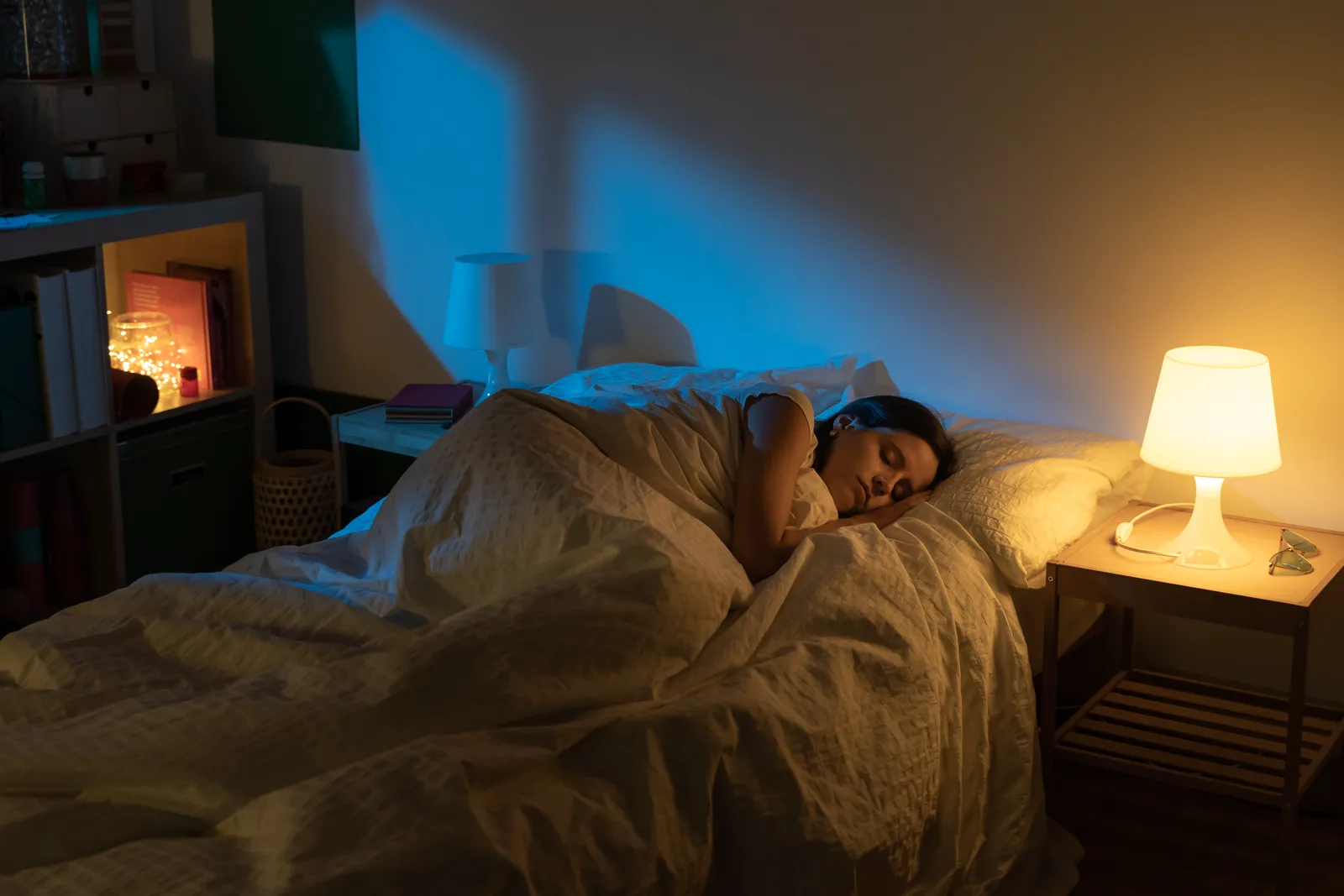
The version that works: get up, go to a different room with very dim warm light, do something low-stimulation (read a paper book, sit in a chair, write down what's worrying you), and return to bed when you actually feel sleepy. No phone at any point. Bright light at 3 AM signals to the circadian system that morning has arrived, which suppresses the melatonin pulse that would have gotten you back to sleep. The phone is the single fastest way to turn a 30-minute waking into a 90-minute one. See our how to reduce screen time before bed guide for the full protocol.
The phone is part of the loop
Most adults who lie awake anxious reach for the phone. The phone is almost always the thing that turns a 15-minute anxious waking into an hour-long one. Pax Gate is the mindful app blocker we built around a different idea than most. Instead of a hard lockout, it puts one small pause in front of the apps you reach for unconsciously. The pause turns into a gratitude prompt, a quick reflection, or a mood check. Three seconds, not a fight. The apps you actually want to use are still there. The apps you reach for at 3 AM without thinking now ask you a question first.
Join the Pax Gate waitlist The cheapest 3 AM intervention you can make is the one that puts the phone down before the phone keeps you up.The longer-term structural fixes
The in-the-moment techniques work for nights you're already in. The structural changes below are what changes the baseline. Each is well-supported and most adults can implement them within a week.
- Phone out of the bedroom overnight. The single highest-leverage structural change for nighttime anxiety in the lived-experience literature. Bedside phone access turns waking into scrolling and scrolling into rumination. A $20 alarm clock removes the only legitimate argument for the phone being on the nightstand.
- Caffeine cutoff by noon. Caffeine's half-life is roughly 5 to 7 hours, but its full clearance is closer to 12. The 4 PM coffee you don't notice is part of the 3 AM wake-up. See our caffeine and anxiety guide for the dose-response math.
- A real wind-down hour. Not a phone-down hour, a wind-down hour. Dim lights, low-stim activity, paper book or conversation. The wind-down doesn't just help sleep onset; it gives the brain time to process unfinished thoughts so they don't ambush at 3 AM. The full architecture is in our before bed guide.
- A worry window earlier in the day. Set aside 15 minutes around 6 PM specifically to worry on purpose. Write the worries down. Most of what would have woken you at 3 AM gets processed during this window instead. CBT for insomnia uses this; the research base is solid.
- Daily movement. Regular exercise is one of the most well-documented anxiety reducers, and the effect is largest in people whose baseline anxiety was higher. Doesn't have to be intense; daily walks measurably move the needle.
- Therapy, if this is a pattern. If nighttime anxiety is a regular feature of your life and the techniques above only treat the symptoms, talking to a therapist (especially one trained in CBT-I or general anxiety treatment) is one of the highest-yield investments most adults can make. This isn't a character claim; it's the same logic as seeing a doctor for a persistent physical symptom.
See what your screen habits might be costing
The Screen Time Cost Calculator estimates what your phone time is costing across hours, sleep, focus, and money. The sleep dimension is the one most relevant here.
Try the Screen Time Cost CalculatorWhen to talk to someone professional
Most nighttime anxiety responds to the techniques and structural fixes on this page. Some doesn't, and that's a useful signal rather than a failure. A few patterns that are worth a conversation with a primary care doctor or a therapist:
- Waking with panic more than once or twice a week, consistently
- Anxiety affecting daytime functioning (focus, mood, relationships, work) over multiple weeks
- Using alcohol or other substances to fall asleep
- Physical symptoms (chest pain, breathing problems) you haven't had checked
- Any thoughts of self-harm
- The anxiety has lasted more than a month and isn't getting better
None of these mean something is catastrophically wrong. They mean you'd benefit from a layer of support beyond what an article can offer. CBT for anxiety has a strong research base, often produces measurable change within 8 to 12 weeks, and is more available than it used to be (most therapists now offer video sessions, and there are app-based and low-cost options for adults whose insurance doesn't help).
Related guides and tools
FAQ
Why do I get more anxious at night?
A few things stack at the same time. The body's cortisol rhythm has a small pulse in the early morning hours, which can pull a light sleeper into consciousness already alert. The day's distractions are gone, so unresolved worries finally catch up. The bedroom is dark and quiet, removing the sensory input that competed for attention during the day. If your nervous system already runs hot, the combination is a near-ideal environment for the brain to spin.
What can I do for anxiety in the middle of the night?
In the moment, evidence-based grounding (paced breathing, progressive muscle relaxation, 54321 sensory grounding, cognitive defusion) works better than trying to talk yourself out of the anxiety. The diagnostic above surfaces a matched technique for what you're experiencing. Most work in 3 to 8 minutes. If you can't get back to sleep within about 20 minutes, get up, go to a different room with very dim warm light, do something low-stim, return when sleepy. No phone.
Why do I wake up panicked at 3 AM?
The 3 to 4 AM waking pattern is unusually common. Cortisol begins rising toward its morning peak around this time, blood sugar tends to be at its lowest, and the brain is in lighter sleep by then so it's easier to surface. If you're already anxious, you can wake in something close to a panic state without having dreamed anything particular. The 54321 grounding technique tends to be the cleanest fit for this specific situation.
Is it normal to have anxiety attacks at night?
More common than most people realize. Nocturnal panic attacks happen in roughly a third of people with panic disorder, but also in people without that diagnosis under high stress. The pattern: you wake at 3 AM, your body is already activated, your brain reaches for an explanation. Standard panic-management techniques apply. If it's happening more than occasionally, it's worth a conversation with a doctor or therapist.
Should I get out of bed when I can't sleep from anxiety?
Yes, after about 20 minutes. This is stimulus control therapy, one of the most evidence-supported sleep interventions. The point is to keep the bed associated with sleep, not with the experience of lying awake. Get up, dim warm light, low-stim activity, return when sleepy. No phone the entire time. Bright light at 3 AM signals morning has arrived, which suppresses the melatonin pulse that would have gotten you back to sleep.
What's the fastest way to calm anxiety at night?
For acute anxiety, paced breathing with a long exhale is the fastest evidence-backed intervention. Inhale 4, hold 7, exhale 8, repeat 4 times. The long exhale activates the parasympathetic nervous system within about 60 seconds. If breathing alone isn't enough, layer 54321 sensory grounding on top. Both are well-studied and reliably reduce acute anxiety within 5 minutes for most people.
Does melatonin help with anxiety at night?
More nuanced than the supplement industry suggests. Melatonin's research base is for sleep onset timing, not anxiety. The anxiety studies are mostly preoperative (the night before surgery) and small samples. For ordinary nighttime anxiety, the evidence is weak. Some people find it helpful indirectly (better sleep equals less anxiety). Others find melatonin (especially the high US over-the-counter doses) produces vivid dreams or grogginess that worsens nighttime mental state. The full picture is in our melatonin and anxiety guide.
When should I see a doctor about night anxiety?
If you're waking with panic more than once or twice a week consistently. If anxiety is affecting daytime functioning over multiple weeks. If you're using alcohol or substances to fall asleep. If there are physical symptoms (chest pain, breathing) you haven't had checked. Any thoughts of self-harm. None of these mean anything is catastrophically wrong; they mean you'd benefit from support beyond an article.
Sources
- Bernstein, D. A., & Borkovec, T. D. (1973). Progressive Relaxation Training. Research Press.
- Borkovec, T. D., Robinson, E., Pruzinsky, T., & DePree, J. A. (1983). Preliminary exploration of worry. Behaviour Research and Therapy, 21(1).
- Clow, A., Hucklebridge, F., Stalder, T., Evans, P., & Thorn, L. (2010). The cortisol awakening response: more than a measure of HPA axis function. Neuroscience & Biobehavioral Reviews, 35(1).
- Goldstein-Piekarski, A. N., et al. (2015). Sleep deprivation impairs the human central and peripheral nervous system discrimination of social threat. The Journal of Neuroscience, 35(28).
- Harvey, A. G. (2002). A cognitive model of insomnia. Behaviour Research and Therapy, 40(8).
- Hayes, S. C., Strosahl, K. D., & Wilson, K. G. (2011). Acceptance and Commitment Therapy: The Process and Practice of Mindful Change (2nd ed.). Guilford.
- Jerath, R., Edry, J. W., Barnes, V. A., & Jerath, V. (2006). Physiology of long pranayamic breathing. Medical Hypotheses, 67(3).
- Morin, C. M., et al. (2006). Psychological and behavioral treatment of insomnia: an update of recent evidence. Sleep, 29(11).
- Vandekerckhove, M., & Wang, Y. L. (2018). Emotion, emotion regulation and sleep. AIMS Neuroscience, 5(1).
One last thing
Nighttime anxiety is one of the most common things adults don't talk about. Almost everyone you know has had nights like this; most of them assume they're the only one. The techniques on this page work. Not every time, not for everyone, but often enough that most people reading this will get something useful from one of them tonight. Save this page, or screenshot the technique that matched, so it's there at the moment you actually need it. The hardest part of anxiety at night isn't the anxiety. It's remembering, in the middle of it, that there's something you can do.