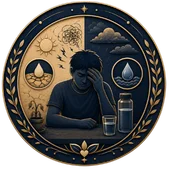
Hydration vs Symptoms Match-Up
Pick what you're experiencing, when you last drank water, and your typical daily intake. The tool surfaces the symptom overlap (how many of your selected symptoms are also classic dehydration symptoms) plus a quick risk assessment. Most people are surprised by the overlap; the same symptoms that read as anxiety also read as dehydration.
Before you assume it's anxiety, drink a big glass of water and wait an hour. If the symptoms drop, it was dehydration. If they don't, you've ruled it out for almost no cost and you can move to the next thing.
Yes, and the research is clearer than most people expect
The dehydration-anxiety connection isn't a wellness blog claim; it's a well-replicated finding from real studies. Two of the cleaner ones are worth knowing about.
Armstrong et al. (2012) ran a study at the University of Connecticut on 25 healthy young women, putting them through controlled mild dehydration (about 1.4 percent body mass loss, which is below the typical thirst threshold). The dehydrated women reported significantly increased anxiety, fatigue, confusion, and tension on validated mood scales, compared to a hydrated control state in the same individuals. The effect sizes weren't small; they were comparable to other documented mood interventions.
Ganio et al. (2011), from the same research group, ran the equivalent study in men. Same pattern. Mild dehydration (about 1.6 percent body mass loss) impaired vigilance, working memory, and mood, with the strongest effects on tension and anxiety. Men and women were comparable in the effect; this isn't a gender-specific finding.
Pross et al. (2014) took the question from the other direction. They studied habitual low-volume water drinkers (people who drank under a liter a day) and increased their intake to 2.5 liters. Within a few days, the participants reported lower anxiety and more positive mood. Going the other way (taking habitual high drinkers down to low intake) increased reported anxiety and reduced positive affect.
Translation: across multiple controlled studies in healthy adults, mild dehydration produces measurable anxiety and mood effects, and rehydration reverses them within days. This is one of the more robust findings in the lifestyle-and-mood literature. It doesn't mean dehydration causes every case of anxiety; it does mean it's almost certainly a contributor in a meaningful share of cases, and the contribution is fixable.
How dehydration produces anxiety physically
Several mechanisms operate at once, and the combined effect is larger than any one of them. Knowing the mechanism is useful because it explains why the symptoms feel so similar to anxiety; the body is doing roughly the same things in both situations.
Cortisol release
Dehydration is a low-grade physical stressor, and the body responds by releasing cortisol. Studies have measured cortisol increases from even mild dehydration, particularly when paired with exercise or heat. Cortisol is the stress hormone, and elevated levels produce the physical anxiety profile (faster heart rate, higher blood pressure, alertness, restlessness) directly. The brain often catches up to the body and assigns an emotional label to what's already happening physically.
Increased heart rate and blood viscosity
As body water decreases, blood volume decreases. The heart compensates by pumping faster to maintain blood flow. The faster heart rate is the same physical signal the brain reads in anxiety. Blood also becomes slightly more viscous when dehydrated, which makes the heart work harder still. For someone prone to noticing their heartbeat, this is often the most distinctive dehydration symptom that gets misread as anxiety.
Reduced cerebral blood flow
The brain is sensitive to small changes in hydration. Studies using neuroimaging have shown that even mild dehydration reduces cerebral blood flow and changes brain activation patterns, particularly in areas involved in attention and mood regulation. This is the mechanism behind the brain fog, difficulty concentrating, and the "I can't think straight" feeling that often accompanies dehydration. The cognitive impairment then amplifies the anxiety, because thoughts feel less manageable when the brain is operating at reduced capacity.
Electrolyte and blood sugar shifts
Dehydration is rarely just water loss; it usually includes some loss of electrolytes (sodium, potassium, magnesium). These minerals are involved in nerve signaling, and shifts in their balance can produce symptoms ranging from muscle cramps to lightheadedness to heart palpitations. Dehydration can also slightly affect blood sugar regulation, and low blood sugar produces its own anxiety-like symptoms (shakiness, irritability, racing thoughts).
The symptom overlap most people miss
Here's a side-by-side most popular articles don't show. The same set of physical symptoms can be produced by both dehydration and anxiety. When you experience them, the question isn't "anxiety or not" but "anxiety, dehydration, or both?"
Symptoms common to both
- Rapid heartbeat
- Heart palpitations
- Lightheadedness or dizziness
- Difficulty concentrating
- Fatigue
- Brain fog
- Irritability
- Headache
- Trouble sleeping
- General sense of unease
- Shallow breathing
- Restlessness
More specific to dehydration
- Dry mouth
- Dark or scant urine
- Muscle cramps
- Decreased skin elasticity
- Sunken eyes
- Constipation
More specific to anxiety
- Specific worried thoughts
- Catastrophizing
- Avoidance of specific situations
- Worry that's hard to name
- Hypervigilance
- Sense of dread tied to a person, place, or event
The middle column is the diagnostic one. If your symptoms are mostly from the first list, dehydration is on the differential and worth ruling out first. If your symptoms include the third list, anxiety is more likely the driver. Most people have some of both. The rehydration experiment (drink a large glass of water, wait an hour, see what's left) is one of the cheapest diagnostic tests available.
Why thirst isn't a good early indicator
This is one of the more counterintuitive findings in the hydration literature, and it's the reason adults so often go through the day mildly dehydrated without realizing.
Thirst is a lagging signal. By the time the body's thirst response activates, you're already at roughly 1 to 2 percent body water loss, which is the exact range where studies show mood and cognitive effects appear. The thirst response gets you to drink before things become dangerous, but it doesn't keep you in the optimal range. The signal evolved when humans had to walk to a stream; it's calibrated for survival, not for peak cognitive performance.
The implication: relying on thirst to tell you to drink is reliably under-drinking. The version of hydration that prevents the anxiety and cognitive effects is drinking on a schedule (or with consistent habits like a glass with each meal, a glass on waking, a glass with the morning coffee) rather than reactively. This is part of why hydration tracking apps exist and partly why many adults adopt a "16 oz on waking" habit; both work by getting the morning catch-up done before the day's natural dehydration sets in.
Factors that increase dehydration risk
Daily water needs vary a lot more than the "8 glasses a day" rule suggests. Several factors meaningfully increase what you need.
- Caffeine. Coffee and tea are mildly diuretic. The net hydration effect is still positive (you do get most of the water content), but heavy caffeine days require additional water. A 4-cup-of-coffee day means an extra cup or two of water to maintain balance.
- Alcohol. Significantly dehydrating. Alcohol suppresses antidiuretic hormone, causing increased urine output. One drink produces roughly 1 to 1.5 cups of urine. The next-day anxiety after drinking is partly hangover, partly dehydration-driven.
- Exercise and heat. Sweat is mostly water with electrolytes. An hour of moderate exercise produces around 16 to 32 ounces of fluid loss. Hot environments accelerate it even without exercise.
- Salty or processed food. High-sodium foods pull water into the digestive tract and increase urine output. Restaurant meals and packaged foods are typically much higher sodium than home cooking; days with multiple eating-out meals tend to be higher-dehydration days.
- Many common medications. SSRIs and SNRIs (often prescribed for anxiety, ironically), antihistamines, diuretics (used for blood pressure), and some ADHD medications all increase dehydration risk. Worth knowing about, especially if you started a new medication and noticed more anxiety symptoms.
- Illness. Fever, vomiting, diarrhea all accelerate fluid loss. Recovery from illness often takes longer than expected because hydration deficits persist after the symptoms resolve.
- Aging. The thirst response weakens with age. Adults over 65 are at substantially higher risk of chronic mild dehydration than younger adults, often without realizing it.
How much water do you actually need
The honest answer: individual needs vary, but most adults reading this article are probably under-drinking. The general National Academies guidelines:
- Women: 2.7 liters (91 oz, roughly 11 cups) per day from all sources, including food.
- Men: 3.7 liters (125 oz, roughly 15 cups) per day from all sources, including food.
Roughly 20 percent of daily fluid comes from food (especially fruits and vegetables, which are 70 to 90 percent water by weight). The actual liquid-drink target is more like 9 cups for women and 12 cups for men, with that varying based on the factors above.
The simplest practical approach: keep a reusable bottle of a known volume (a 24 oz bottle is convenient), drink one with breakfast, one mid-morning, one with lunch, and one in the afternoon. That's 96 oz from drinks alone, well into the target range. Adjust up for exercise, heat, alcohol, or salty days.
The simplest experiment in the anxiety toolkit
If you got this far and you're not sure whether dehydration is contributing to your symptoms, run the test. It's free, it takes an hour, and it gives you actual data on your own body.
- Drink 16 to 24 oz of water (a large glass or a normal bottle) right now.
- Continue with whatever you were doing.
- Check back in 60 to 90 minutes. Notice how you feel.
- If the symptoms have dropped noticeably (calmer heart rate, clearer head, less edge), dehydration was contributing.
- If nothing changed, dehydration probably wasn't the main driver, and the other interventions in the related guides below are worth trying.
The test is repeatable. If you suspect dehydration is a recurring issue, run the experiment when you notice symptoms over the next few days. A consistent positive result is strong evidence that hydration is a meaningful daily lever for you. A consistent negative result rules it out cleanly.
The phone doesn't help you remember water
One of the quieter side effects of heavy phone use is forgotten basics. Eating, drinking water, standing up, looking out a window. The default modern day skips a lot of small body care while the phone is in hand. Pax Gate is a mindful app blocker built around a different idea than most. Instead of a hard lockout, it puts one small pause in front of the apps you reach for without thinking. The pause turns into a gratitude prompt, a quick reflection, or a mood check with Pax, your panda companion. Three seconds, not a fight. Many users find the pause becomes a natural reminder for the small things, including drinking water.
Join the Pax Gate waitlist The small habits that keep you human in the modern day are the ones the phone is best at eating. Pax Gate puts a few of them back.If anxiety is keeping you up at night
The companion guide. A 3 AM toolkit with evidence-based grounding techniques you can do in bed, the research on why nights are different, and the structural fixes that hold.
Read the night anxiety guideWhen dehydration isn't the answer
Hydration is rarely a complete solution to anxiety, even when it's a meaningful contributor. A few patterns where the rehydration experiment will come back negative or only partially positive, and other interventions are warranted:
- If you've been adequately hydrated for several days and the anxiety hasn't shifted.
- If the anxiety is tied to specific worries, situations, or thoughts (the third symptom column above).
- If panic attacks are occurring more than occasionally.
- If the anxiety has lasted more than a few weeks and is affecting daily functioning.
- If you have an underlying anxiety disorder being treated by a doctor.
None of these mean hydration is irrelevant; staying hydrated is still useful as a baseline. They mean hydration alone isn't doing the work, and other guides in this series, or a conversation with a doctor or therapist, are the next step.
Related guides and tools
FAQ
Can dehydration cause anxiety?
Yes. Controlled studies have shown that even mild dehydration (1 to 2 percent body water loss) measurably increases anxiety and impairs mood. Armstrong et al. (2012) found this in women; Ganio et al. (2011) found the same in men. Mechanisms include cortisol release, increased heart rate, reduced cerebral blood flow, and electrolyte shifts. All of these are physical signals the brain reads as anxiety.
What does dehydration anxiety feel like?
Often indistinguishable from regular anxiety. Common overlap: rapid heartbeat, lightheadedness, difficulty concentrating, fatigue, headache, brain fog, irritability, feeling on edge. People often interpret these as anxiety and look for emotional causes when the actual cause is physical and fixable. The match-up tool above is designed to surface this overlap.
How much water do I need to prevent anxiety?
The National Academies guidelines: 2.7 liters per day for women, 3.7 liters for men, from all sources including food. About 20 percent comes from food, so the actual fluid target is 9 cups for women and 12 cups for men. These are averages; needs vary with body size, activity, heat, caffeine, alcohol, and medications.
Why does drinking water reduce anxiety?
Three mechanisms. Restoring hydration reduces cortisol and normalizes heart rate. The act of drinking is a brief parasympathetic activation. And addressing a real physical cause removes a real contributor to anxiety. Pross et al. (2014) found measurable mood improvements within days of increased water intake in habitual low drinkers.
How long does it take to rehydrate?
For mild dehydration, 16 to 20 oz of water produces measurable rehydration within 30 to 60 minutes. Improved alertness, lower heart rate, and lower anxiety usually appear in the same window. For moderate or chronic dehydration, full restoration takes a day or two of consistent intake. The practical test: drink a large glass, wait an hour, see what changed.
Does coffee count toward hydration?
Yes, mostly. Coffee is mildly diuretic but the net hydration effect is positive. Studies have found coffee contributes about 80 to 90 percent as much to hydration as the same volume of water. Tea and most caffeinated beverages are similar. Alcohol, by contrast, is significantly dehydrating; it suppresses antidiuretic hormone and increases urine output.
What are the warning signs of dehydration?
Early: dry mouth, dark or scant urine, fatigue, mild headache, difficulty concentrating, slight dizziness, irritability. Moderate adds: rapid heartbeat, more dizziness, muscle cramps, decreased skin elasticity. Severe (rare in adults with access to water): rapid breathing, low blood pressure, confusion, fainting. Thirst is a lagging signal; by the time you feel it, you're already 1 to 2 percent dehydrated.
Can dehydration cause panic attacks?
Indirectly, yes. The cardiac symptoms produced by dehydration (rapid heartbeat, palpitations, lightheadedness) are common panic triggers in susceptible people. The panic-prone brain reads the cardiac symptoms as threat and amplifies them. People with panic disorder often find consistent hydration reduces both panic frequency and severity.
Sources
- Adan, A. (2012). Cognitive performance and dehydration. Journal of the American College of Nutrition, 31(2).
- Armstrong, L. E., et al. (2012). Mild dehydration affects mood in healthy young women. Journal of Nutrition, 142(2).
- Ganio, M. S., et al. (2011). Mild dehydration impairs cognitive performance and mood of men. British Journal of Nutrition, 106(10).
- Maughan, R. J., Watson, P., Cordery, P. A., et al. (2016). A randomized trial to assess the potential of different beverages to affect hydration status. American Journal of Clinical Nutrition, 103(3).
- National Academies of Sciences, Engineering, and Medicine. (2005). Dietary Reference Intakes for Water, Potassium, Sodium, Chloride, and Sulfate.
- Popkin, B. M., D'Anci, K. E., & Rosenberg, I. H. (2010). Water, hydration, and health. Nutrition Reviews, 68(8).
- Pross, N., et al. (2014). Effects of changes in water intake on mood of high and low drinkers. PLOS ONE, 9(4).
- Sawka, M. N., Burke, L. M., Eichner, E. R., Maughan, R. J., Montain, S. J., & Stachenfeld, N. S. (2007). American College of Sports Medicine position stand. Exercise and fluid replacement. Medicine and Science in Sports and Exercise, 39(2).
One last thing
Almost everything else in the anxiety series requires time, effort, or a real behavioral change. This one doesn't. It requires a glass of water and an hour of attention. If the test comes back positive, you've found one of the cheapest levers available, and the daily implementation is the same glass of water on a slightly more regular schedule. If the test comes back negative, you've ruled out a contributor and the other guides in this series are where to look next. Either way, you got the answer almost for free. There are very few interventions in modern life with that kind of cost-to-information ratio. Run the test before reading anything else.