

The Personalized Prompt Generator
Pick your current state, a life area, and how much time you actually have. The Generator returns a 3-prompt matched set you can write to, save, or screenshot. The prompts are anchored to the Pennebaker expressive writing paradigm, which is the part of the journaling literature with the strongest evidence base.
Each generated set has three prompts: one quick, one medium, one deeper. Pick whichever fits the time you actually have. Save the set (screenshot it) so you have it at the moment you'd actually use it.
Hundreds of prompts already, in the moment you'd otherwise scroll
The Generator above gives you 3 prompts on demand. The real problem with any prompt list, including this one, is remembering to use it when you need it. Pax Gate solves this directly. It's a mindful app blocker with hundreds of prompts already built in. When you reach for the apps you scroll without thinking, instead of a hard lockout, you get one small pause with a prompt to respond to. Three seconds. Not a fight. The prompts surface at the exact moments most people lose to the phone, which is the same moment a journal prompt would have helped if you'd thought to reach for one.
Join the Pax Gate waitlist The prompts are good. The bigger gift is the timing. The phone in your hand becomes the place a prompt is waiting for you.The journaling that happens beats the journaling you plan. Three minutes with a prompt you actually had on hand beats 30 minutes with a perfect prompt you never opened.
The research on what actually makes journaling work
Most journaling content treats "journaling" as a single practice that either works or doesn't. The research is more specific than that, and knowing which form of journaling is which tends to help substantially.
The Pennebaker expressive writing paradigm
James Pennebaker has been studying expressive writing since the mid-1980s and is the most-cited researcher in this space. The original 1986 study (Pennebaker & Beall) found that writing for 15 to 20 minutes about a traumatic or emotionally significant experience, four sessions across one week, produced measurable improvements in mood, immune function, and physician visits over the following months. The effect has been replicated dozens of times across different populations and topics.
The key features of the paradigm that the research actually supports: specific experiences rather than vague "how are you feeling," genuinely emotional material rather than safe topics, at least 15 minutes per session, and multiple sessions rather than one-offs. Stream-of-consciousness journaling about your day doesn't quite fit the paradigm and has weaker evidence.
The Frattaroli meta-analysis
Frattaroli (2006) meta-analyzed 146 studies of expressive writing and confirmed a small-to-moderate but reliable effect on psychological and physical health outcomes. The effect was largest for people with elevated baseline distress and smaller for already-flourishing people, which is what you'd expect from an emotional processing intervention. Effects tend to be larger when participants are given more freedom in what to write about and when the writing is genuinely private (not shared).
What this means in practice
If you're journaling for mental health benefits specifically, the format with the strongest evidence is roughly this: 15 to 20 minutes per session, focused on emotionally significant material, 3 to 5 sessions in your first week, private, with the freedom to write whatever surfaces. That's the Pennebaker protocol. After the initial week, shorter daily entries (5 to 10 minutes) maintain the practice and keep self-awareness building.
The prompts in the Generator above and the categories below are written with the Pennebaker findings in mind. They're specific, open-ended, focused on emotionally significant material, and time-scaled.
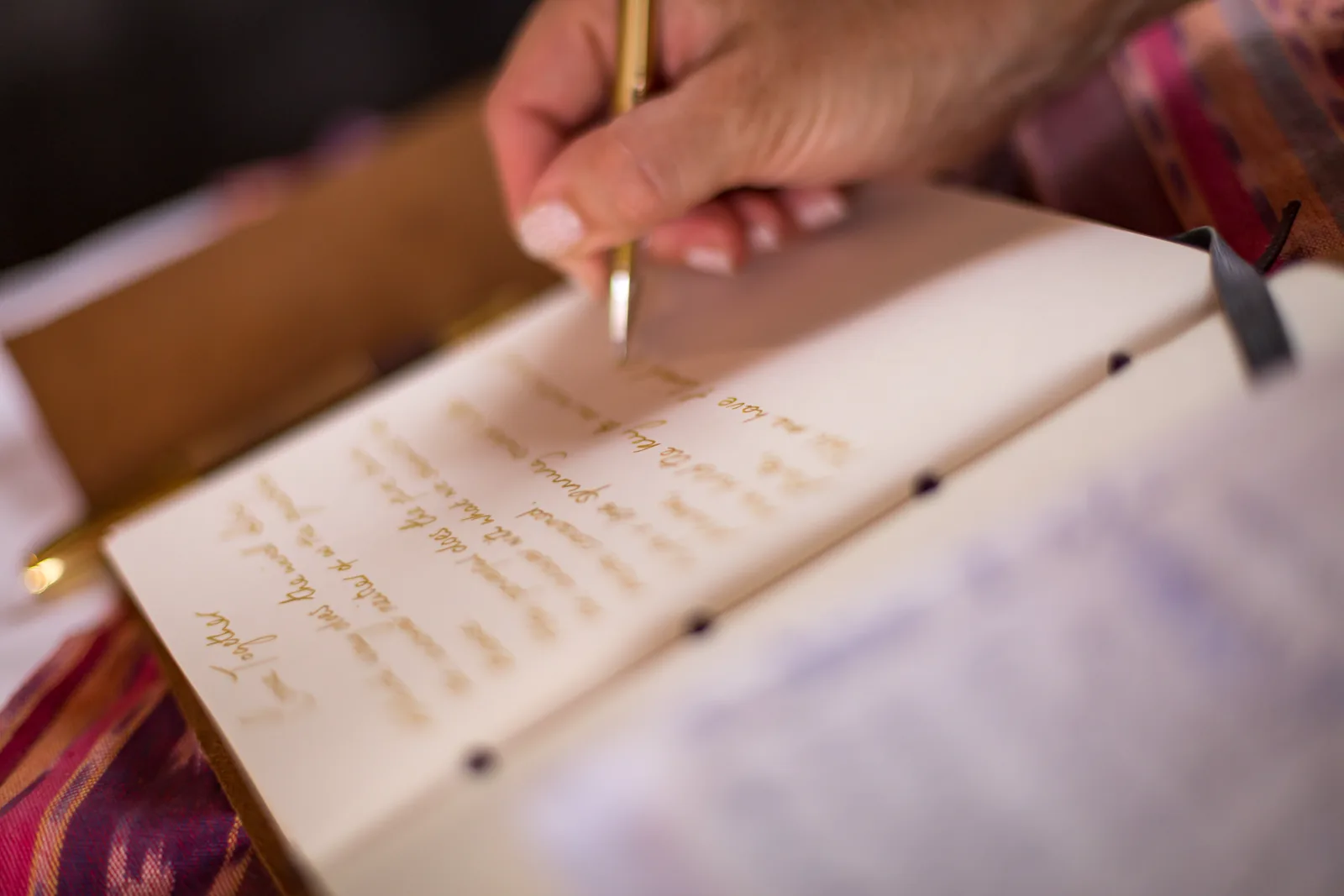
50+ research-anchored prompts by category
The categories below mirror the Generator's structure but in static form, so you can save the ones that resonate. Each set has 5 to 7 prompts of varying depth. The bias is toward specificity over generality, because specific prompts produce better writing than generic ones.
When your mind won't slow down
Useful for the racing-thoughts pattern, especially at night. The point isn't to argue with the anxiety; it's to write it onto the page so the brain stops feeling like it has to carry the whole thing alone.
- What specifically am I afraid will happen? Name the actual scenario, in detail.
- If that did happen, then what? Write the next step. Then ask "then what" of that step. Continue until you reach something concrete.
- List three things I was anxious about a year ago. How did each one actually play out?
- Where in my body is the anxiety right now? Describe the physical sensation in 3 sentences.
- What would I tell a close friend who described this exact worry to me?
- What's the most useful thing I can do in the next hour, and what would I be doing if the worry weren't running?
When you want to know what you actually think
Some of the best journaling sessions are the ones where you find out what you believe by writing it. These prompts are slower and more open. They tend to surface things you'd been carrying without quite knowing.
- What's a belief I hold that, if I'm honest, I'm not sure I actually believe?
- What do I want, that I haven't given myself permission to say out loud yet?
- When was the last time I felt completely like myself? What was happening?
- What's something I've been carrying that nobody knows about yet?
- If the next year of my life looked exactly like the last year, what would I be sad about?
- What do I do when nobody's watching, and what does that say about me?
When something happened and you're still in it
The Pennebaker paradigm in its most direct form. Pick the situation. Set a timer. Write through it. Don't edit. The research base for this form of journaling is the strongest in the literature.
- The thing I haven't been able to stop thinking about, in detail, without filtering.
- What was hardest about what happened? What surprised me about my own reaction?
- What did I lose, even if nobody else would call it a loss?
- What do I wish someone would say to me about this?
- Write a letter I'll never send to the person involved. Say everything.
- What's true now that wasn't true a month ago? What's still true that I wish weren't?
When the goal is noticing what's already here
Gratitude journaling has a real research base (Emmons & McCullough 2003, Lyubomirsky) but works best when specific rather than rote. "Three things I'm grateful for" produces less than these prompts because the specificity is what makes the practice land.
- Something small that worked today that I almost didn't notice.
- A person in my life who I haven't told lately how much they matter to me. Why do they matter, specifically?
- Something I have today that the version of me from 5 years ago would have been thrilled about.
- A skill or capability I have that I take for granted but that took real work to develop.
- Something about my body that works well, that I rarely thank it for.
- A place I'll miss when I'm gone. Describe it in detail.
When you're stuck on something specific
Writing about a decision tends to produce different answers than thinking about it. The act of putting words to options externalizes them, which is most of what's needed to move forward.
- State the decision in one sentence. Then in three. Then in ten.
- What would I do if I trusted my gut here? What would I do if I trusted my head? What's the difference?
- What am I actually afraid of losing if I pick the option I'm leaning toward?
- What would the next 10 years look like under each option, in concrete terms?
- Whose opinion am I most afraid of, and why does it have that weight?
- If a friend brought me this exact decision, what would I tell them? Why am I not telling myself the same thing?
For the conversations you can't quite have yet
Useful for working out what you actually think before a hard conversation, or for processing a relationship that's confusing you. Often the writing is the conversation, in the sense that getting clear is most of the work.
- What am I not saying to this person, and what would happen if I did?
- What story am I telling myself about their behavior? What other stories could also fit the same facts?
- What do I need from them that I haven't asked for directly?
- Where is this relationship asking me to grow, even when I don't want to?
- What would I want them to know about me that they don't currently see?
- What's one thing I could say or do this week that would move the situation, even slightly?
For figuring out what actually matters
Values work tends to produce surprisingly different answers than people expect going in. The prompts below get under the easy default answers.
- What's something I'd be willing to be uncool about because it matters to me?
- What's the difference between what I value in theory and what my calendar and bank account suggest I value?
- What's a value I inherited that I never chose, and am I keeping it or releasing it?
- If I had to write a 1-paragraph description of who I want to be at 70, what would it say?
- What's a hill I'd actually die on, and what would I never bother to defend?
- What would my younger self think of how I'm spending my time right now?
For setting the day before it sets you
Morning journaling tends to do better for direction-setting than for processing. Short prompts, 3 to 7 minutes, before the phone.
- What's the one thing today that, if I do it, would make today feel like a win?
- How do I want to feel by 6 PM? What's one choice this morning that gets me closer?
- What's been on my mind that I haven't given words to yet?
- Who in my life could use a small kindness today, and what would it cost me to do it?
- What am I trying to avoid today, and is it worth what I'd save by avoiding it?
For closing the day cleanly
Evening journaling tends to do better for processing and release. Slightly longer prompts, 5 to 15 minutes, before bed. Pair with the before-bed guide for the full wind-down.
- What happened today that I want to remember?
- What's still running in my mind from today? What would it take to put it down?
- One small thing I'm proud of from today, even if it wasn't on the list.
- What would tomorrow's version of me thank me for handling tonight?
- What was hard today, and what did I learn about myself from how I handled it?
The Pennebaker protocol, applied
If you want to run the version of journaling with the strongest research support, here's the protocol in plain form.
- Pick one emotionally significant topic. Something recent, something heavy, something you've been carrying. Doesn't have to be trauma; it should be something that has emotional weight when you bring it to mind.
- Set a timer for 15 to 20 minutes. Pick a quiet space. Don't get up.
- Write without stopping. Pen on paper or keys on keyboard. No editing. If you don't know what to write, write "I don't know what to write" until something else comes. The continuous writing matters; pauses break the flow that produces the effect.
- Write through the whole time. Don't quit early even if you feel done. Often the deeper material surfaces in the second half.
- Don't reread for at least a few hours. Sometimes never. The processing happens in the writing, not in the rereading.
- Repeat for 3 to 4 consecutive days. Same topic or related topics. The cumulative effect is larger than any single session.
After the initial 3 to 4 sessions, you can switch to shorter daily entries to maintain the practice. The Pennebaker effect, in the research, persists for months after the initial protocol. It isn't something you need to do every day for the rest of your life; it's something you do when you have material that genuinely needs processing.
Common pitfalls
Writing what you should feel rather than what you do feel
The single most common journaling mistake. The brain has a script for "what a healthy person would write here" and reaches for it automatically. The script produces dead writing that doesn't help. The fix: notice when you're writing the script and write what you actually feel underneath it instead. The underneath is the part that produces the research-grade effects.
Trying to be eloquent
The journal isn't a publication. Run-on sentences are fine. Repetition is fine. Profanity, contradictions, half-thoughts, all fine. The act of writing produces the benefit, not the prose quality.
Skipping it on the bad days
The days you most want to skip journaling are often the days the research suggests journaling produces the largest benefit. Heavy day = good Pennebaker session. The pattern of skipping heavy days and journaling on light days inverts the actual leverage.
Reading old entries with a critic's eye
Most people who reread their journals do it harshly. The judgment is its own anti-practice. If rereading isn't useful, don't reread. The entries did their work in the writing.
Treating consistency as moral weight
You don't have to journal every day for it to count. The 3-day-a-week practice that holds for a year produces more benefit than the "every day" practice that lasts two weeks and dies of guilt.
If you want the structural sleep work
Evening journaling pairs naturally with a real wind-down hour. The before-bed guide has the Wind-Down Sequence Builder, the sleep biology, and the three bedroom rules that hold.
Read the before-bed guideWhen journaling isn't enough
For most adults, journaling is a useful daily tool. Some patterns warrant a step beyond it:
- If journaling about the same situation week after week and nothing shifts, a therapist often unlocks what the page can't.
- If journaling produces dissociation or feels destabilizing, particularly for trauma material, a trauma-trained therapist is the right level of intervention.
- If the writing surfaces thoughts of self-harm, please call or text 988 (US), Samaritans 116 123 (UK), or your local crisis line.
- If you've been journaling consistently for months and your mental health hasn't shifted, journaling may be working but the bigger structural issues (sleep, relationships, work, substance use) need direct attention.
Related guides and tools
FAQ
What are good journal prompts for mental health?
The prompts with the strongest research base are built around Pennebaker's expressive writing paradigm. Pennebaker (1986 onward) found that writing for 15 to 20 minutes about emotionally significant experiences, four days in a row, produced measurable improvements in mood, immune markers, and physical health. The prompts that work in that paradigm are specific (about a particular situation), open-ended, and focused on what you actually feel rather than what you think you should feel. The Generator above and the 50+ prompts later in this guide are all built to that standard.
Does journaling actually help mental health?
Yes, with caveats about what kind. Frattaroli (2006) meta-analyzed 146 studies of expressive writing and found a small-to-moderate but reliable effect on psychological and physical health outcomes. Effects are largest for people with elevated baseline distress. The format that produces effects is specific: focused writing about emotionally significant experiences for 15 to 20 minutes, multiple sessions. Casual stream-of-consciousness journaling has weaker evidence.
How long should I journal for mental health?
The Pennebaker protocol, which has the strongest research support, is 15 to 20 minutes per session, four sessions across roughly a week. For sustained practice, 5 to 10 minutes a day with a real prompt produces useful self-awareness benefits even if it doesn't match the research-protocol effect sizes. Under 5 minutes tends to be too short to engage emotionally significant material.
What should I write about when journaling for anxiety?
Three approaches that work. The worry-and-then-what (name the worry, then write the next step, continue until concrete). The body check-in (where in your body is the anxiety, what does it feel like). The past-anxiety inventory (three things you were anxious about a year ago and how they actually played out). The Generator includes prompts in each of these veins.
How often should I journal?
More often than rules-of-thumb suggest, in shorter sessions than people typically attempt. Short daily entries (3 to 7 minutes) paired with occasional longer sessions for harder topics. The journaling that actually happens beats the journaling you plan. Tie the practice to an existing habit to make consistency more likely.
Is it better to journal in the morning or at night?
Different effects. Morning journaling tends to do better for setting intentions, processing dreams, and surfacing what's running in the background. Evening journaling tends to do better for processing the day and releasing tension. The research doesn't clearly favor one. The version that holds is the one you'll actually do.
What if I don't know what to write?
That's exactly what prompts are for. The most common failure mode in journaling is staring at a blank page; the prompt removes the friction. Use the Generator above or pick a prompt from the categorized list. A useful starting prompt when nothing else lands: "What's on my mind right now that I haven't given words to yet?" Start writing whatever surfaces, even if it sounds like nothing.
Should I journal by hand or on a screen?
By hand if you can, on a device if that's what makes you actually do it. Handwriting tends to slow processing speed enough that more emotional integration happens. But the research is clear that typed expressive writing produces real effects, and the journaling that happens beats the journaling that doesn't.
Sources
- Burton, C. M., & King, L. A. (2004). The health benefits of writing about intensely positive experiences. Journal of Research in Personality, 38(2).
- Emmons, R. A., & McCullough, M. E. (2003). Counting blessings versus burdens: An experimental investigation of gratitude and subjective well-being in daily life. Journal of Personality and Social Psychology, 84(2).
- Frattaroli, J. (2006). Experimental disclosure and its moderators: A meta-analysis. Psychological Bulletin, 132(6).
- Lyubomirsky, S., Sousa, L., & Dickerhoof, R. (2006). The costs and benefits of writing, talking, and thinking about life's triumphs and defeats. Journal of Personality and Social Psychology, 90(4).
- Pennebaker, J. W. (1997). Writing about emotional experiences as a therapeutic process. Psychological Science, 8(3).
- Pennebaker, J. W., & Beall, S. K. (1986). Confronting a traumatic event: Toward an understanding of inhibition and disease. Journal of Abnormal Psychology, 95(3).
- Smyth, J. M., Stone, A. A., Hurewitz, A., & Kaell, A. (1999). Effects of writing about stressful experiences on symptom reduction in patients with asthma or rheumatoid arthritis. JAMA, 281(14).
One last thing
If you've tried journaling and it didn't stick, the issue probably wasn't the prompts. It was the moment of need. Almost nobody opens a notebook in the exact moment a prompt would have helped most; instead they reach for the phone. The setup is backwards. Get the prompts to where your hand already goes, which is the device that's already in your pocket. That's most of what the Pax Gate callout above is about. The hundreds of prompts already in the app surface at the moments you'd otherwise scroll, which is also the moment a journal prompt would have helped if you'd been holding a notebook. Same hand, different content. That's the whole pitch, and it's the version that actually holds for most adults who've tried journaling and found themselves not doing it.