
What Opal does well
Opal's superpower is cross-device blocking. If you scroll on your phone, then keep scrolling on your Mac, Opal can block both at once, which most tools in this space simply cannot do. The Pro tier includes scheduled focus sessions, detailed stats, and Opal Squads, a social-accountability layer where you set goals with friends or coworkers. The app feels genuinely premium and polished, and the stats are legitimately useful for anyone who likes a productivity-metrics view of their attention. If you want a serious, well-built focus tool that spans your devices, Opal is one of the best in the category and earns its reputation.
Where Opal may fall short
Two things, and neither is a knock on the quality of the app. First, price: Opal Pro runs about $80 to $100 a year, which is at the high end of this category, and it is more than many people need if they only want their phone handled. Second, framing: Opal is built around productivity, with stats, streaks, and squads. That is a genuine motivator for some people and a source of low-grade pressure for others. If what you actually want is to feel less pulled by your phone rather than to optimize a focus score, the productivity lens can feel like one more performance metric on a life that already has enough of them. Opal is excellent at what it is; it is just aimed at a slightly different goal than presence.
You work across your phone and a Mac all day and want the same block on both. You would actually use group accountability with friends or coworkers. You enjoy detailed productivity stats and want a polished premium app. You are happy spending $80 to $100 a year for the right tool. If cross-device focus and metrics are the job, Opal does it as well as anyone.
Your phone is the real problem, not your laptop, so cross-device is a feature you would pay for and not use. You would rather build a calm habit than chase a focus streak. The productivity framing feels like pressure rather than motivation. Or the yearly price is simply more than you want to spend to handle a phone habit. If any of those land, a lighter, presence-first tool may fit you better.
How Pax Gate is different
Pax Gate is phone-only, on purpose. The core problem it is built for is the moment you reach for your phone, and that moment does not need a cross-device solution. The framing is not "be more productive." It is "be more present." Instead of stats and squads, Pax Gate replaces the metrics with a gratitude practice, a sanctuary you can build and decorate, and a panda companion named Pax. The pause at unlock turns into a small prompt (a gratitude note, a reflection, a noticing exercise) rather than a focus timer. The aesthetic is calm and warm rather than corporate, and the price is meaningfully lower: free to try, paid for the full experience.
Honest caveats: Pax Gate does not do cross-device blocking or productivity squads, so if those are what you want, Opal is the better tool and we will say so. And Pax Gate is Android-first, with iOS planned, while Opal is on iOS, Android, macOS, and Chrome today. If you are on iPhone and want something now, Opal is a real option, and you can join the Pax Gate waitlist for the iOS release.
Presence instead of a productivity scoreboard
Tap any screen to open it full size.


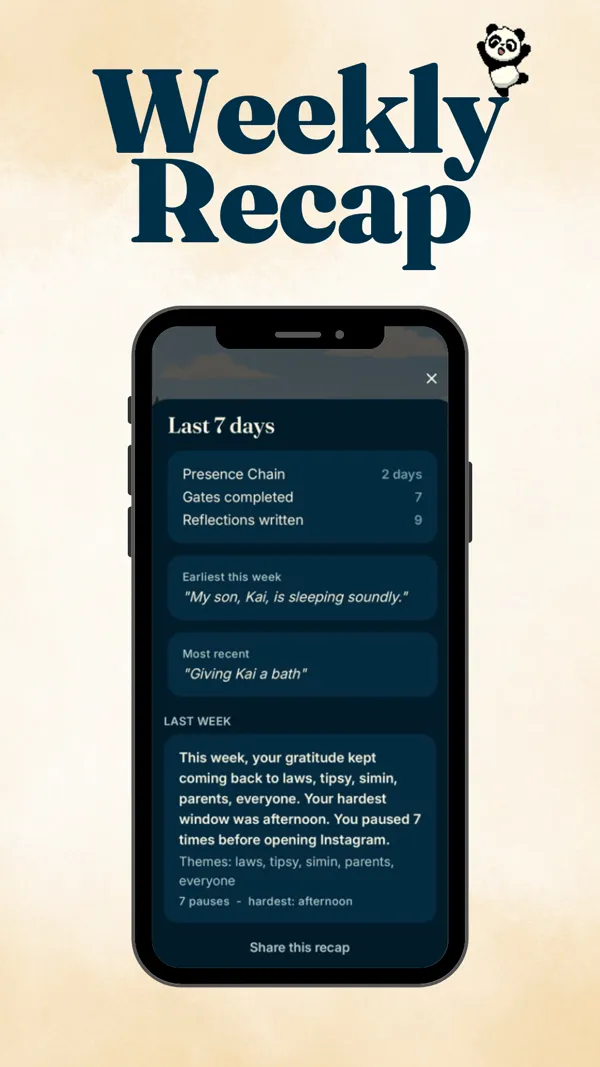
Your phone is the issue, not your laptop. You want a pause and a practice, not productivity metrics. You would rather build a gratitude habit than a focus streak, prefer a calmer aesthetic, and want a lower price (free core, paid practice extras). You are on Android, or happy to join the waitlist for iOS.
Feature comparison
| Opal | Pax Gate | |
|---|---|---|
| Style of friction | Scheduled blocks and timed focus sessions | Pause at unlock with a gratitude or mindfulness prompt |
| Platforms | iOS, Android, macOS, Chrome | Android first (iOS planned) |
| Cost | About $80 to $100 a year for Pro | Free to try; paid for the full experience |
| Cross-device | Yes (its main strength) | Phone only |
| Focus | Productivity stats and squads | Gratitude, prompts, rituals, sanctuary |
| Aesthetic | Premium, productivity focused | Cream and gold, designed to feel calm |
| Companion | No | Yes (Pax the panda) |
| Social accountability | Yes (Opal Squads) | No; designed for solo practice |
Best choice by use case
- You block across a phone and a Mac all day: Opal. Cross-device is its signature strength.
- You want the pause to build a gratitude or mindfulness habit: Pax Gate. That is the whole point of the practice layer.
- You love productivity stats and group accountability: Opal, which does both well.
- You want a calmer, lower-cost tool for the phone specifically: Pax Gate, free to try and cheaper than Opal Pro.
- You are on iPhone and want something today: Opal now; join the Pax Gate waitlist for the iOS release.
Try Pax Gate
Join the waitlist for early access. Presence over metrics: a gratitude pause, a sanctuary, and Pax the panda.
Join the Pax Gate waitlist Android first, iOS planned. We will tell you plainly when your platform is ready.Want to compare more than two apps?
The Pax Gate Comparison Tool puts Pax Gate side by side with ScreenZen, Opal, Forest, and One Sec, with an honest verdict for each.
Open the Comparison ToolCompare other alternatives
FAQ
What does Opal do best?
Opal's standout strength is cross-device blocking. If you scroll on your phone and then keep scrolling on your Mac, Opal can block both at once, which most competitors cannot. Its Pro tier adds scheduled focus sessions, detailed productivity stats, and Opal Squads, a social-accountability feature. The app is genuinely premium and polished, and if you like a productivity-metrics view of your attention, the stats are among the best in the category.
Why look for an Opal alternative?
Two common reasons. Price: Opal Pro runs about $80 to $100 a year, at the higher end for this category. And framing: Opal is built around productivity, with stats and squads, which is great if that motivates you but can feel like one more performance metric if what you want is to be more present. If your issue is the phone specifically, and you would rather build a calm habit than chase a focus score, a lighter, presence-focused tool may fit better.
How is Pax Gate different from Opal?
Pax Gate is phone-only, on purpose, because the moment it is built for is the phone pickup. The framing is not be more productive; it is be more present. Instead of stats and squads, Pax Gate gives you a pause that turns into a gratitude prompt, a sanctuary you can build, and a panda companion named Pax. The aesthetic is calm rather than corporate, and the price is meaningfully lower: free to try, paid for the full experience. Pax Gate is Android-first with iOS planned.
Is Pax Gate cheaper than Opal?
Yes. Opal Pro is roughly $80 to $100 a year. Pax Gate is free to try, with a paid tier for the full experience that is meaningfully less than Opal's, and a free tier that includes the core pause-at-unlock blocker without paying. That said, Opal's cross-device blocking and stats are things Pax Gate does not do, so if you need those, the higher price may be worth it. If you mainly need the phone handled with a mindful pause, Pax Gate does that for less.
Does Pax Gate work across my phone and laptop like Opal?
No. Cross-device is Opal's signature strength and Pax Gate does not compete on it. Pax Gate is phone-first and currently phone-only, because the moment it is built for is the phone pickup, not desktop focus sessions. If a meaningful part of your distraction happens on a Mac or in a browser and you want one tool to block both, Opal is the better pick. If your phone is the real issue, Pax Gate handles that with a mindful pause.
Can I use Pax Gate on iPhone?
Not yet. Pax Gate is Android-first, with an iOS version planned. Opal is on iOS, Android, macOS, and Chrome today, so if you are on iPhone and want something now, Opal is a real option, especially for cross-device blocking. You can join the Pax Gate waitlist to be notified the moment the iOS version is ready.