
What AppBlock does well
AppBlock is a capable, flexible blocker, and especially strong on Android. It blocks apps and notifications on schedules and even at set locations, supports multiple profiles for different situations (work, sleep, weekend), and offers a strict mode that makes a block genuinely hard to disable once it is running. It layers on usage stats and quick-block options too. For someone who wants scheduled, enforceable blocking with granular control over exactly when apps and their notifications are available, AppBlock is powerful, mature, and hard to fault on capability.
Where AppBlock may fall short
Scheduled hard blocking is enforcement, not change, and enforcement can feel like punishment. AppBlock is excellent at saying no on a schedule, but a block that fights you often turns into a quiet game of working around it, and when the schedule lifts the underlying habit is exactly where it was. The interface is also utilitarian and feature-dense, closer to configuring a firewall than building a calmer relationship with your phone, which is right for power users and heavy going for people who just want something gentle. If the goal is to actually retrain the mindless-pickup reflex rather than lock it behind a schedule, a tool built around reflection rather than restriction may fit better.
You want scheduled and location-based blocking with fine-grained control. You need to block notifications, not just app access. You value a strict mode that you cannot easily disable in a weak moment. You are comfortable with a feature-dense, utilitarian interface and like configuring profiles. If enforceable, granular blocking is the job, AppBlock is a strong, capable pick.
Your issue is the reflexive, mindless pickup rather than a need to enforce a schedule. You have found strict blocks turn into something you resent and disable. You want the tool to gently change the habit, not just lock it out during set hours. You would rather open something calm than configure a firewall. If any of that lands, a pause-and-reflect approach may suit you better.
How Pax Gate is different
AppBlock enforces; Pax Gate reflects. Instead of blocking an app on a schedule or behind a strict mode, Pax Gate places a short, intentional pause at the moment you open a chosen app, filled with a gratitude prompt, a reflection, or a check-in with Pax, the panda companion. You keep your agency, so there is nothing to fight or work around, and over weeks the pauses build a practice that changes the reflex rather than merely holding it back. The whole experience is warmer and simpler by design: calm cream-and-gold rather than a dense control panel, a companion rather than a rule set. It is built to make the mindless pickup a little more mindful, one pause at a time.
Honest caveats: Pax Gate does not block notifications or offer scheduled and location-based blocking, so if those are what you need, AppBlock is the better-suited tool. And Pax Gate is Android-first, with iOS planned. AppBlock is on Android and iOS today. If you are on Android and want the pause approach, you can join the Pax Gate waitlist now; iPhone users can join for the iOS release.
Reflection, not a control panel
Tap any screen to open it full size.
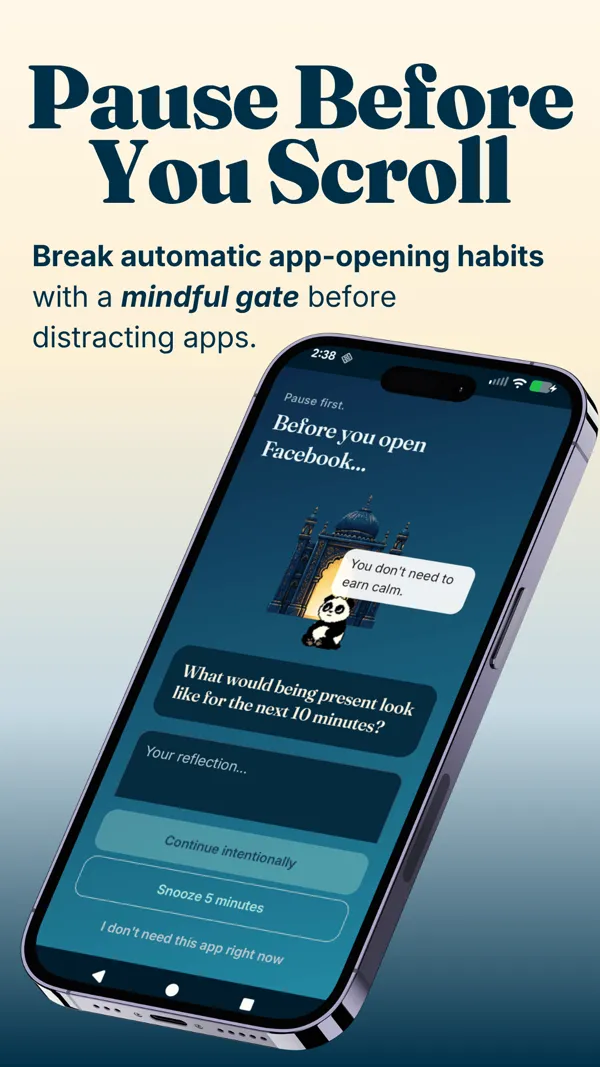
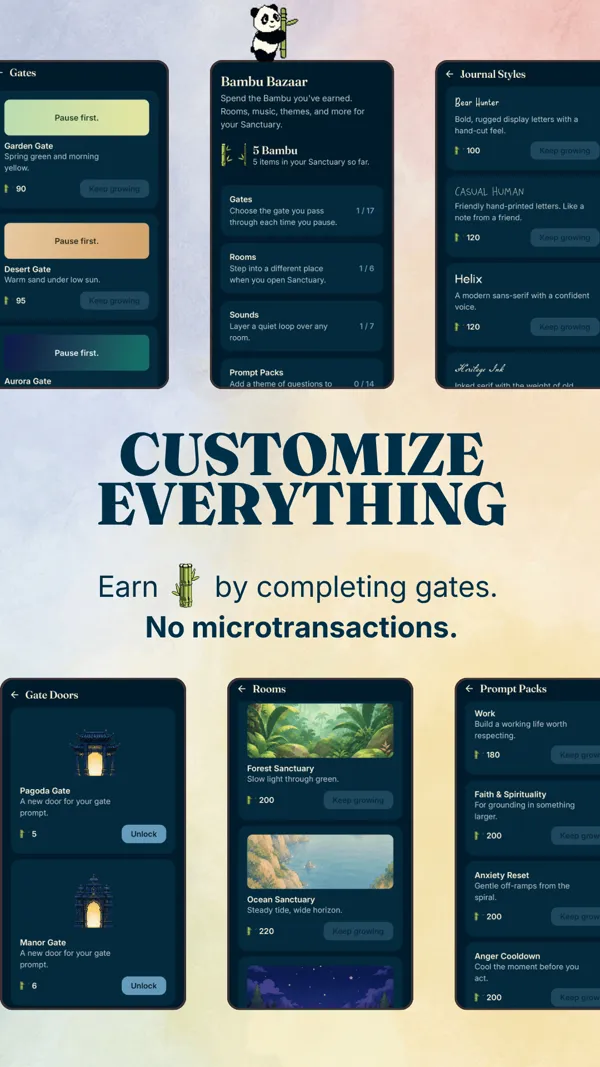
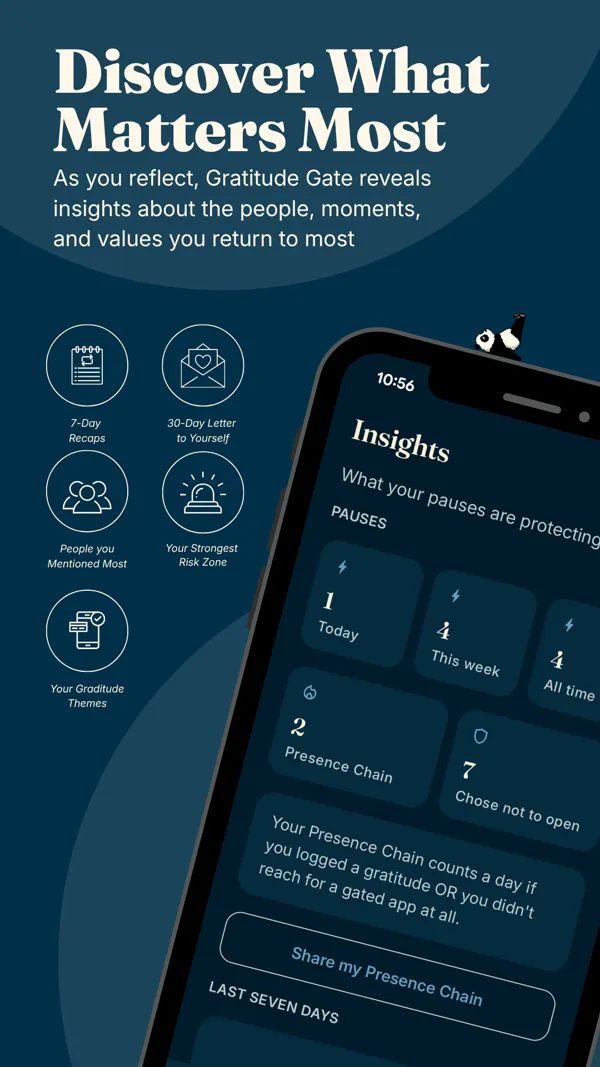
Your problem is the mindless, reflexive pickup rather than a need to enforce a schedule. You want the pause to keep your agency and slowly retrain the habit rather than fight it. You would rather build a gratitude practice than configure profiles and strict modes. You want something calm and simple. You are on Android, or happy to join the waitlist for iOS.
Feature comparison
| AppBlock | Pax Gate | |
|---|---|---|
| Mechanism | Scheduled blocks, profiles, strict mode | Pause at unlock with a gratitude or mindfulness prompt |
| Approach | Enforce (say no on a schedule) | Reflect (wait, breathe, then choose) |
| Platforms | Android, iOS | Android first (iOS planned) |
| Cost | Freemium (premium subscription) | Free to try; paid for the full experience |
| Blocks notifications | Yes (a strength) | No; acts at unlock |
| Builds a habit | No; enforces during windows | Yes (gratitude practice over time) |
| Companion | No | Yes (Pax the panda) |
| Aesthetic | Utilitarian, feature dense | Cream and gold, designed to feel calm |
Best choice by use case
- You need scheduled, location-based, or notification blocking: AppBlock. It is powerful and granular here.
- You want to change the mindless-pickup reflex, not just enforce a schedule: Pax Gate, whose pause is built for that moment.
- You want a strict mode you cannot disable in a weak moment: AppBlock, which does strict enforcement well.
- You would rather reflect than configure a control panel: Pax Gate, calm and simple by design.
- You are on Android and want a gentler habit-builder: Pax Gate. Join the waitlist for early access.
Try Pax Gate
Join the waitlist for early access. A pause that reflects instead of a block that enforces, with Pax the panda at the gate.
Join the Pax Gate waitlist Android first, iOS planned. We will tell you plainly when your platform is ready.Want to compare more than two apps?
The Pax Gate Comparison Tool puts Pax Gate side by side with ScreenZen, Opal, Forest, and One Sec, with an honest verdict for each.
Open the Comparison ToolCompare other alternatives
FAQ
What does AppBlock do well?
AppBlock is a capable, flexible blocker, especially on Android. It blocks apps and notifications on schedules and at set locations, supports multiple profiles, and offers a strict mode that makes a block genuinely hard to disable once running. It also gives usage stats and quick-block options. For scheduled, enforceable blocking with granular control over when apps and notifications are available, AppBlock is powerful and well established.
Why look for an AppBlock alternative?
Because scheduled hard blocking is enforcement, not change, and enforcement can feel like punishment. AppBlock is excellent at saying no on a schedule, but a block that fights you often turns into a game of working around it, and when the schedule lifts the habit is unchanged. The interface is also utilitarian and feature-dense. If you want the tool to gently retrain the mindless-pickup reflex rather than lock it out, a pause-and-reflect approach may suit you better.
How is Pax Gate different from AppBlock?
AppBlock enforces; Pax Gate reflects. Instead of blocking an app on a schedule or behind strict mode, Pax Gate puts a short pause at the moment you open a chosen app, filled with a gratitude prompt, a reflection, or a check-in with Pax the panda. You keep your agency, so there is nothing to work around, and over weeks the pauses build a practice that changes the reflex. Pax Gate is warmer and simpler by design, Android-first with iOS planned, free to try, paid for the full experience.
Does Pax Gate block notifications like AppBlock?
No. Notification blocking is one of AppBlock's strengths, and Pax Gate does not do it. Pax Gate works at the moment you open an app, with a mindful pause, rather than by suppressing notifications or scheduling app availability. If a large part of your problem is being pulled in by notifications, or you want scheduled and location-based blocking, AppBlock is better suited. If your problem is the reflexive, mindless open, Pax Gate's pause is built for that moment.
Is a pause or a strict block better for mindless phone use?
It depends on the shape of the habit. A strict block like AppBlock is better when you need to guarantee an app is unavailable during a window, such as work or sleep. A pause like Pax Gate is better for mindless, reflexive use throughout the day, because the whole issue is autopilot, and a pause interrupts it while keeping you in control. Many people find a strict block during ordinary hours becomes something they resent and disable, whereas a gentle pause is one they keep long enough for the habit to shift.
Can I use Pax Gate on iPhone?
Not yet. Pax Gate is Android-first, with an iOS version planned. AppBlock is on Android and iOS today, so if you want scheduled blocking right now on either platform, it is an option. If you are on Android and want the pause-and-reflect approach, join the Pax Gate waitlist for early access now; iPhone users can join to be notified when the iOS version arrives.